Data analytics is no longer just for big corporations with deep pockets. Small businesses are now leveraging the power of data to make smarter decisions and gain a competitive advantage. In this blog post, we’ll explore best practices and solutions that small businesses can use to get the most out of their data analytics efforts.
Start with Clear Goals and Objectives Before diving into data analytics, it’s important to define clear goals and objectives. What do you want to achieve with your data? What insights are you hoping to gain? By starting with clear goals, you can focus your efforts and avoid getting lost in the data.
Collect and Clean Data Regularly Data quality is critical to the success of data analytics. Inaccurate or incomplete data can lead to incorrect conclusions and bad decisions. Small businesses should make sure that data is collected regularly and cleaned to remove any errors or duplicates.
Use Cloud-Based Analytics Tools Small businesses can take advantage of cloud-based analytics tools to streamline their data analytics efforts. Cloud-based tools are cost-effective and scalable, allowing small businesses to start small and grow as their needs change.
Implement Visualization Techniques Data visualization techniques can help small businesses make sense of complex data sets. By using charts, graphs, and other visualizations, small businesses can quickly identify trends and patterns that might not be apparent from raw data.
Embrace Machine Learning and AI Machine learning and AI technologies are becoming more accessible to small businesses. These technologies can help small businesses automate routine tasks and make predictions based on historical data. For example, machine learning algorithms can be used to predict which customers are most likely to make a purchase or which products are likely to sell out.
Protect Your Data Data privacy and security should be a top priority for small businesses. It’s important to implement best practices for data protection, such as using secure passwords, limiting access to sensitive data, and backing up data regularly.
In conclusion, small businesses can use data analytics to gain a competitive advantage in their industries. By starting with clear goals, collecting and cleaning data regularly, using cloud-based analytics tools, implementing visualization techniques, embracing machine learning and AI, and protecting data, small businesses can make smarter decisions and achieve their business objectives.
Cookies have long been a source of controversy in the digital world, with concerns around data privacy prompting web browsers to phase out their use. As we move towards a cookieless future, businesses that rely on cookies for lead generation will need to adapt their strategies to maintain their competitive edge.
What are cookies and why are they becoming obsolete?
Cookies are small text files that are stored on a user’s device when they visit a website. They contain information about the user’s browsing behavior, which can be used by marketers to target them with personalized ads. However, cookies have been linked to privacy concerns, as they can be used to track users across the web. Additionally, web browsers like Google Chrome, Firefox, and Safari are now blocking third-party cookies by default.
What does this mean for lead generation?
The phasing out of cookies will have a significant impact on lead generation. Marketers will need to find new ways to identify and target potential customers, without relying on cookies. This is where first-party data comes in. First-party data is data that is collected directly from the user, such as information collected through sign-up forms or account registration. This data is more reliable and can be used to create a personalized experience for the user.
Another alternative to cookies is contextual advertising. Contextual advertising involves targeting ads based on the content of the webpage that the user is viewing, rather than their browsing history. This approach is less invasive and respects the user’s privacy.
Transparency and trust will also be key in the cookieless future. Businesses will need to be more transparent about their data collection practices and ensure that they are complying with data privacy regulations such as GDPR and CCPA. By being transparent and building trust with their customers, businesses can create a better user experience and improve their lead-generation efforts. In conclusion, the cookieless future is here, and businesses that rely on cookies for lead generation will need to adapt their strategies to stay competitive. By embracing first-party data, contextual advertising, and transparency, businesses can continue to generate leads in a privacy-friendly way.
The ’90s. The last ten years before everybody started to have a phone close by. A period not long before innovation truly dominated. Life was somewhat increasingly slow (would contend less unpleasant) without virtual entertainment feeds to look over each time we were only a tad bit exhausted.
What’s more, without even a trace of new tweets and TikTok patterns to stay aware of constantly, we turned somewhere else for diversion. In particular, we went to the numerous comical and endearing 90s sitcoms that were on each week.
Not in the least did any semblance of Uncle Jesse (show kindness!), George Costanza, Ross and Rachel (and their Companions), and Zack Morris (among numerous others) keep us chuckling, they additionally showed us some important life examples that — in the event that you resembled me growing up around then — you took as undeniable guidance for how to explore life’s harder minutes.
A fourth of 100 years (express out loud whatever?!) later, I’m here to let you know how a portion of those examples can be applied straightforwardly to content showcasing. Seriously, there’s a thing (or a few) that you can truly detract from a portion of our #1 significant episodes.
In this way, right away: 6 substance advertising examples I gained from watching 90s television.
Quick Takeaways
Content marketing is always evolving. Marketers must be willing to embrace change and step out of their comfort zones to keep up.
Timing matters — failing to make a plan and stick to it can lead to lost opportunities.
Resourceful tactics like repurposing old content boost the ROI you earn on content assets.
Outsourcing to an agency can help you execute your content strategy with more confidence while you focus on other strategic priorities.
Content Marketing Lessons We Learned from 90s Sitcoms
Sometimes It’s Good to Do the Opposite
When you’re not getting the results you want from your content strategy, take a little advice from George Costanza and do the opposite. In this episode of Seinfeld, George laments that the decisions he’s made thus far in life have all been wrong, and Jerry sagely advises him:
“If every instinct you have is wrong, then the opposite would have to be right.”
Now I’m not suggesting your decisions have all been as wrong as George’s, or that you flip your entire content strategy on its head to do the exact opposite of what you’re doing now. The takeaway as I see it is about not simply digging your heels in and sticking to the plan, even when it’s not working.
Be willing to be like George and admit when something’s not going as expected, then figure out how to adjust. Content best practices evolve and change like any other part of business, and there’s a lot to get right when it comes to making Google’s algorithms happy, engaging the right target audience, and creating content that actually converts.
Undoubtedly, there will be times when you don’t get it right the first time and need to do some trial and error to get back on course.
The content marketing lesson: Keep trying. Keep improving. Do the opposite of what your instincts tell you when your instinct isn’t working. Do your research and adjust your strategy until it succeeds.
Change is Hard (But You’ve Got to Embrace It)
Uncle Jesse moving out of the house. Mr. Feeney dismissed his students after the last day of school. Will Smith stand in an empty house after his family leaves for the final time? If there’s one thing we know from 90s sitcoms, it’s that change is inevitable and it feels tough.
As a content marketer trying to keep up with the latest content trends and best practices, it’s a feeling you’re probably familiar with yourself.
For example There once was a time when all you had to do to get content ranking on Google was stuff it full of your target keyword and press publish. But Google (and its users) got smarter, and today the algorithm’s expectations for content quality are much more sophisticated.
It was a change met with resistance and even resentment as marketers realized they’d need to do more to create competitive content. But the brands that won are those that embraced the change to get ahead.
Here’s the lesson: Content marketing is fast-changing. New tools and technologies come out, trends come and go, and user expectations evolve. Embrace it all. Keep up with it. It keeps your content fresh, relevant, and engaging for your audience.
Great One-Liners Grab Attention
When you watched an episode of Family Matters and things went inevitably wrong on screen, you could count on Steve Urkel to turn around and ask with an aloof smile, “Did I do that?” Inevitably, when Friends’ Joey Tribiani saw an attractive woman, you waited expectantly for his “How you doin’?”
When someone didn’t give Stephanie Tanner her way on Full House? You knew you’d hear an exasperated “How rude!” Blossom heartthrob Joey Russo stole hearts with a single “Whoa!”
Many of our favorite 90s TV characters became so beloved because of the familiarity behind their signature taglines. If our attention veered for a moment, you could count on these lines to grab it back to see what was happening.
And while brand taglines might be more relevant to direct advertising, there are important lessons we can take away from content marketing too. Namely, a single line — a blog headline, email subject line, etc. — is what grabs your audience’s attention and makes them decide to stick around.
Consider this: 8 of 10 people will read your blog headline, but only 2 out of 10 will read your full blog. About a third of email recipients decide whether or not to read an email based solely on the subject line. No matter how great your actual content is, you’ve got to get the headline right if you want them to actually read it.
Sometimes You’ve Got to Be Resourceful
When Uncle Jesse, Stephanie, and Michelle got locked in a mechanic’s garage on the morning of Michelle’s birthday party, they could have thrown their hands up and called it quits. After all, they planned and purchased for the party happening at the house, and now all they had to work with was the equipment locked in the garage with them.
So what did they do? They got resourceful. They looked internally for things they could use to recreate a birthday party. What resulted (at least for kids like me watching from the couch) was just about the best party a girl could want.
As content marketers, we often end up in situations where our budget doesn’t stretch as far as we want it to or we just don’t have the bandwidth to get everything done that we planned for a given time period. But you still have to publish. You still have to engage your audience.
Just like Stephanie and Jesse used auto equipment to turn the garage into a circus, you can look right inside your own library of content for ways to keep your strategy active.
Repurposing or reusing content is a powerful way to keep web traffic flowing to your site. In fact, HubSpot found they earned 76% of their blog views from old articles they updated.
The takeaway: Don’t feel like you have to reinvent the content wheel every time—especially when you’re feeling stretched too thin.
Look at your current content library for ways to boost activity. Repurpose content on other platforms. Give older articles a refresh and repost. Rather than stressing about what you can’t do, look to maximize ROI on what you already have.
Timing is Everything
There were two types of people in the 90s: those that thought Ross and Rachel were on a break, and those who thought they weren’t. The will-they-won’t-they storyline between these two Friends characters was a staple of 90s pop culture, and if you tuned in, you know timing never seemed to be on the couple’s side.
Take the scene pictured above, when Rachel finally decides to tell Ross how he feels, only to be unexpectedly introduced to his new girlfriend. Ross loved Rachel, but she waited too long. To put it in content marketers’ terms, she lost her guy to a competitor.
Timing is debatable in the content marketing industry — the best day and time to publish your blogs or send an email or publish a new social media post largely depends on your audience and your industry (although there are general best practices to follow).
We’re thinking of timing here more holistically. It’s essential to plan your strategy ahead of time so you can keep things consistent, build traffic reliably over time, and capitalize on opportunities like seasonal demand or new product launches.
Using a content calendar to plan your timing and stick to your plan is one of the smartest ways to put this important lesson into practice.
Otherwise? Your brand might end up like Rachel at the airport, watching potential customers (even those who may have loved your brand) go with other brands who got to them first.
It’s Okay to Ask For Help
Tim “The Tool Man” Taylor was notorious for trying to do everything himself — as he often liked to proclaim: “A real man doesn’t need a manual.” He even shrugged off the help of his loyal assistant, Al Borland, which led to many a home improvement disaster when things inevitably got out of his control.
While Tim’s stubbornness may have been a shtick, it offers a valuable lesson for founders and marketing leaders: Content marketing can’t be a one-man show, and trying to do it all on your own will likely lead to wasted effort and poor results.
It’s understandable, especially for startups and growing small businesses, to want to save on costs by executing your content strategy in-house, even when you don’t have the resources to do it. The problem is that you end up with lower ROI and less time to focus on what matters most to your business — serving your customers.
The lesson here is that it’s okay (and smart) to ask for content marketing help when you need it.
Outsourcing content is an alternative that’s proven effective for most companies (84% outsource content in some way) and can offer you convenient bundled services, access to key tools and expertise, and easier scalability than is possible when you hire an in-house team.
Client procurement is the backbone of any business. It’s the main impetus behind showcasing systems and generally speaking business development.
It’s additionally very aggressive and more costly than any other time in recent memory — client procurement cost (CAC) has expanded over 60% in only the beyond six years. Sounds overwhelming, isn’t that so?
It’s certainly a test in the present oversaturated computerized commercial center, where each organization(?) has sites, online journals, paid promotions, and web-based entertainment, and that’s just the beginning. Be that as it may, those equivalent computerized channels offer a colossal chance to draw in new clients securing content — and in addition to any happiness.
We’re talking great, client-centered, search engine-oriented, special, imaginative substance that gets consideration and converts web guests into paying clients.
Truth be told, essentially every organization realizes that computerized content is significant. Yet, far fewer of them are remaining laser-centered around making a quality substance that really performs as opposed to the poop most organizations let out.
We are demonstrating each and every day with our own clients that becoming savvy about happy assists you with securing more clients all the more rapidly, more reasonably, and quicker than your opposition.
Quick Takeaways:
Great content drives customer acquisition by building brand trust, an important motivator of purchase decisions.
You can optimize your content strategy for customer acquisition by creating content for every stage of the buyer journey.
Brands can capitalize on existing content by continually optimizing their best-performing posts and web pages.
Gated content like high-value lead magnets drives acquisition by capturing contact information.
Social proof is another important creator of brand trust and assures customers your brand will deliver on its promises.
The Connection Between Customer Acquisition and Content
Like savvy companies leveraging digital opportunities to find and convert customers, consumers are smart when it comes to choosing brands and making purchases. Traditional marketing tactics of the past — catchy taglines, sales language, and the like — are not enough anymore to capture their interest.
This dilemma? It’s why content has become so important to customer acquisition.
Consumers are not just looking for the brand with the best marketing slogan of the moment — they’re looking for brands they can trust. Research has found that 81% of consumers cite brand trust as an important factor in their buying decisions. They rated it above any other company factor or attribute outside of direct product quality and value.
The research proves that being a helpful provider of thought leadership content will win you, new customers.
To boot, the same study found that 76% of consumers pay attention to ads from brands they trust, versus only 48% for brands they don’t trust.
Where do consumers go to establish the trust they value so highly? Your content. By creating and publishing consistent, high-quality content, you establish credibility and brand authority, build your brand’s personality, and provide value for consumers that tells them your brand can deliver what they need.
Why Content is the Key to Customer Acquisition
Content vs Ads
Most people think marketing is just ads. It’s the annoying stuff that interrupts the content you are trying to consume. Watching the Superbowl? Nope, we’re gonna serve up 3 ads first. Reading an article from Forbes? Nope, we’re gonna pop up an ad for something you are not interested in. Ads don’t work. And everyone knows it. But that’s what most people think marketing is.
We use the term “content marketing” to refer to the kind of content that actually helps people. It’s what marketing is supposed to be. And marketing’s main goal is to acquire new customers.
Content marketing works because it is written by people for people. It works because it is intended to help you get educated, share experiences, and drive you forward. Content marketing works better at acquiring new customers because its goal is to help, not sell.
Content for Search, Email, and Social
Want to rank for search engines? Don’t try using ChatGPT for that! In order to rank for search engines, you simply need to answer the search intent of the keywords and questions your buyers are asking.
When you create content that ranks, it also works well in email and social media. You see, search still matters! A lot.
Content ROI
Ok, now we’re really getting into it. I said the main reason to use content marketing for customer acquisition is that it works. There is a famous marketing stat that content marketing leads cost 62% less than traditional marketing. And that’s because content marketing is better at attracting and converting new customers for less money.
At SAP, our content marketing platform delivered $7 in revenue for every dollar we spent. That’s a 7X ROI. Guess what the ROI was of the rest of marketing? Around 1x. In other words, marketing barely paid for itself. (In fairness, we influenced hundreds of millions of dollars of pipeline that didn’t get “credited” to marketing)
Content + Paid
There’s a lot of talk about AI taking over content marketing. And while we’ve proven that nonsense wrong, it is true that it’s getting harder, not easier, to acquire new customers through organic means. One way to supplement organic content acquisition is through paid.
I’m not talking about banner ads that have 99 problems and a click ain’t one. I’m talking about paid content marketing. We take our best client content and promote it around the web. Then we re-target those readers with later-stage offers.
Our CPC is 90% less than the industry average and our click-through rate is 20x higher. Paid content marketing works for customer acquisition as well!
How to Ace Customer Acquisition with Content
Align your Content with the Buyer Journey
You might hear that any traffic is good traffic when it comes to website visitors. To some extent that can be true, especially when your company is new and your main goal is increasing awareness. But when it comes to powering customer acquisition with content, you need to get intentional.
That means matching your content up with your buyer’s journey.
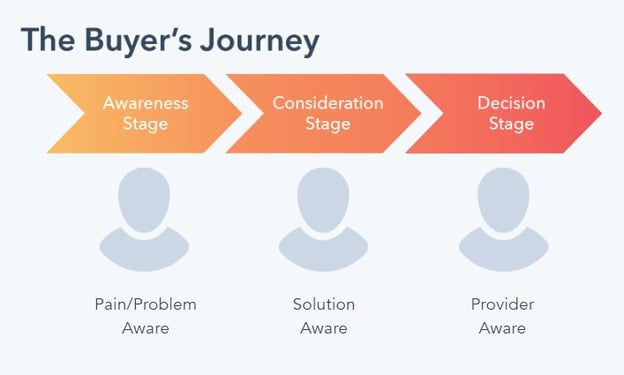
As your buyer moves through the sales funnel, the content that best matches the intent of their visit to your website will change. Someone doing their first Google search on a product or service they need is likely looking for more information about the problem they’re experiencing, meaning content like your top-of-the-funnel blog posts would be really relevant.
Someone later in the stages of the buying process might be looking for confirmation that your brand is indeed the one to choose, and that person might be better convinced by a whitepaper or in-depth case study.
Here’s a great visual to help you think more about the kinds of content that belong in each stage:
When you’re thinking about aligning your content with the buyer journey, you always want to think of two things:
Giving potential buyers the information they need at their current stage
Including a Call To Action (CTA) or other motivator to pull them into the next stage of the buyer journey
Get Serious About Your Blog
Your blog is the foundation of your content marketing strategy. It’s great to know that you need a blog, and by now most companies do. But it’s not enough to just publish content — even if it’s fairly relevant to your industry — and hope it will perform.
Your blog content must be consistent and customer-focused. Always be extremely intentional with your blog content. Use categories to organize your content in ways that align with your content goals with customer search intent and your buyer journey.
You can start with SEO keyword research and a current content audit, then build from there. For more on the process, check out our guide to choosing blog categories and content themes.
You can set up your blog for success by combining your content optimization tactics with close attention to backend technical details that help your blog perform, including blog visibility on your home page and main navigation, using article page templates, configuring URLs, and more.
(Or maybe you need a weekly blog service from us?) 😜
Optimize your Best Performing Content
Optimizing your best content is the low-hanging fruit strategy of enhancing your customer acquisition with content. You’ve already done all the work, and your work is already paying off — the content is performing well and driving traffic to your website.
Now it’s time to take it a step further so it converts that traffic into leads and sales.
Here’s how you can find and optimize your best content:
Visit tools like Ahrefs or Semrush and search for your domain.
Click on “organic keywords” to access a list of keywords you rank for and their corresponding URLs
Once you can see which content is ranking high, do a deeper dive using other tools on these platforms or by doing your own research. Be sure they’re as optimized as possible. Mainly, be sure they rank for the right keywords and have tactics in place to capture visitor information (like gated content, CTAs, subscription forms, and more).
One of our favorite tricks is to find articles that used to perform well and update them. This post was originally published in 2018 but we updated it with the latest stats, links, and information. Here are some tips for updating your old posts.
Leverage High-Value Gated Content
Gated content, also known as lead magnets, captures visitor information by offering them something extremely high-value in return. Gated content comes in many forms, but it always offers something different and more valuable than what your visitors can access in your free content.
So, for example, if your blog covers why content audits are important, your gated content could be a complete PDF guide to performing a content audit.
Some of the most commonly used (and effective) types of gated content include ebooks, whitepapers, checklists, templates, and how-to videos.
Create Videos
Video is currently the most in-demand type of content by online users across the board, and brands are responding accordingly (86% of companies currently use video as part of their marketing strategy). Cisco predicts that video will account for 82% of all online traffic by next year.
The good news? You don’t need to have expensive video production equipment to produce great videos that can drive customer acquisition.
Companies (and most people around the world) are using smartphones to record and share high-quality video content. Simply creating social media stories is an effective way to make your brand visible to customers. As you get better at the video (or can afford more resources), you can expand your strategy.
Other exciting video marketing trends you can try include vlogging, live online events, webinars, and user-generated content (sharing videos of customers interacting with your product/brand).
Demonstrate Social Proof
Social media alone isn’t enough to acquire new customers. But it can support your content marketing customer acquisition.
Do you look for reviews and testimonials when you’re buying a product or choosing a brand? So does everyone else! Research shows that 88% of consumers trust online reviews just as much as personal recommendations and buyers often read dozens of reviews before making a purchase.
You can power your customer acquisition potential by highlighting social proof throughout your content. Some of the best ways to do this are:
Including reviews and testimonials throughout your website
Publishing case studies that demonstrate your success with other customers
Sharing user-generated content (like online reviews and product photos or videos)
Social proof assures your potential customer that you’ll deliver on your promises. It is often the deciding factor for a customer considering making a purchase. Integrating social proof content into your customer acquisition strategy makes it more likely to convert leads and drive sales.
Grow Your Business with Customer Acquisition Content
If you’re ready to publish content that is always optimized to drive results, Marketing Insider Group has solutions. Our writers can deliver ready-to-publish content every single week for a year (or more!) and our Content Builder Service includes a customized strategy to help you deliver it.
As a B2B marketer, one of the essential objectives for your specialization is to run lead age drives to fill your pipeline with income driving open doors. Most promoting efforts offer the capacity to target explicit personas via search conduct, geographic district, proficient traits, for example, work level, and so on… From that point, your association’s CRM is typically worked around MLA and SLA necessities that recognize what rules a possibility should meet to be acknowledged as a serviceable lead, yes? In any event, that is the way we work over in the NetLine Promoting Office and that is precisely where advertisers are running into inconvenience.
Lead Generation Targeting
Whether the mandate came from your CMO or President, my speculation is that you like most B2B advertisers mean to arrive at senior administration and C-suite at top associations. They’re the crème de la crème! These experts are probably going to convert into prompt income for your organization and you really want more possibilities very much like them. Isn’t that so? I can see you are focusing on necessities now, ‘I will just acknowledge Supervisor level experts or more.’
Unfortunately, that is not unfamiliar to most advertisers. Truth be told, 53% of advertisers that ran content partnership lead age crusades with NetLine in the year did precisely that. However, what you have neglected to acknowledge is that the most dynamic section of experts consuming long-structure business content is outside those boundaries, precisely 30%. Have you at any point dissected the pool of non-senior level possibilities who finished up a structure to download your substance? I know the response, those individuals are essential as a decent as dead to you. The trash in; trash out. In any case, perhaps, quite possibly, you ought to consider that these possibility apparitions are a greater amount of the giving kind.
Research the Marketplace
Let me explain. Marketers are producing an exorbitant amount of content, with plans to do even more this year. But it seems that many may be operating blindly without an understanding of the personas consuming content—who’s engaged, who’s not. To better understand the marketplace of content consumption and first answer the question ‘who is downloading all this marketing content?’ NetLine conducted a research study. The research examined more than 8 million leads generated by content downloads to extract insights on who the active audience is, where they work, etc….NetLine found that the most active job-level segments are mid-level professionals, including Individual Contributors, Senior Employees, Consultants, and Contractors.
Insights
The highest volume of content consumption was reported by Individual Contributors, who produced 20% of total activity. This is an increase of 26% over the prior 12 months. In a comparison of Individual Contributor and Senior Employee activity over senior-level activity, senior-level professionals consumed 35% less content. Additionally, professionals outside the traditional organizational structure, such as Consultants, reported the highest growth. Consultants downloaded 49% more content over the prior 12 months. This is likely an effect of more organizations utilizing Consultants to help grow their business.
Next, the research included a deep dive look into the targeting parameters utilized by hundreds of lead generation campaigns (marketers) run by the world’s largest organizations to startups to better understand the ‘in-demand audience.’ Not only is it valuable to know what the active audience looks like, but it is also super important to understand your competition. How many other marketers are ‘bidding’ on the same audience you are? The idea of bidding is a common thought process when it comes to paid advertising campaigns, but in a sense, it’s just as relevant in content syndication lead generation. However, the most interesting stat we found in this analysis was that while the majority of marketers are seeking the same senior-level professionals; the majority of marketers are ignoring a significant percentage of the available audience. When you add up the numbers, here is the glaring conclusion:
53% of campaigns excluded 30% of the active audience, due to job level filters excluding Individual Contributors, Senior Employees, and Consultants.
That’s a huge miss don’t you think? The most active segment of professionals reading long-form business content is mid-level professionals. These professionals are being ignored by more than half of marketers’ lead-generation campaigns over the past year.
Attack the Influencers
With the majority of marketers neglecting mid-level professionals (Individual Contributors, Senior Employees, and Consultants) it had me thinking, why? These professionals are actually major influencers within an organization. This is a glaring opportunity most marketers have not considered because they have blindly focused their lead generation initiatives on the big C-level fish. Do not continue to make this mistake. Senior-level professionals will remain an important target for lead generation campaigns; however, marketers must realize they do not drive the same level of content consumption activity nor do they make their purchasing decisions in silos.
Pivot focus to the influencers, the diverse profile of professionals within the buying committee, including Managers, Senior Employees, and Individual Contributors—as well as Contractors and Consultants. Build deeper influence within the organization by expanding your target range outside senior leadership and target the professionals that advise them. Deeper influence within the organization will directly build greater credibility, an often underestimated attribute associate to the vendor selection process.
Here’s an advanced targeting tip: when it comes to content syndication lead generation, pivot the target persona for each of your content assets within an initiative to specifically reach professionals known to be aligned with in-market and intent-driven positions. Doing so will allow marketers to translate anonymous personas into further down-the-funnel prospects. If this isn’t easily supported, that means that your content lacks the specificity to attract more niche personas. Think about repositioning your existing asset(s) to speak to these unique audiences in a voice/tone that they will recognize.
Make the Change
The overall demand for long-form business content is increasing, by +36% in the past year. Additionally, 51% of professionals requested more than one piece of content and 20% requested more than five. Marketers need to answer the demand while understanding the realities of the marketplace. I hope you will consider my perspective and more importantly the real data-based research study, 2017 State of Content Consumption and Demand Report for B2B Marketers, with an analysis of real behaviors you need to be aware of.
NetLine’s CEO, Robert Alvin shared his perspective on the research in this post, Optimizing Your Demand Generation Strategy with New Content Research, covering the research from all angles: content, targeting, and lead nurture. I encourage you to check it out. In a prior Marketing Insider Group post, I shared new insight into the Content Consumption Gap with the world. If you have never stopped to think about the complexities of lead follow-up on long-form content, read this article: B2B Marketers: Wrong Way to Make the Right Impression on Your Prospects.
In summary, our research—of real behavior—shows that mid-level professionals are highly engaged with long-form content. B2B marketers have the potential to reach a greater volume of quality professionals that can be highly influential in the future decision-making process. This is a massive lead generation opportunity and one where you can beat your competition (clearly!) Pivot your targeting strategy today.
HubSpot, the client relationship the board (CRM) stage for scaling organizations, today reported the send-off of two new instruments fueled by computerized reasoning (artificial intelligence) – a content colleague and ChatSpot.ai – to assist its clients to save time while making better associations with their crowds.
The presentation of content collaborator and ChatSpot.ai expands on HubSpot’s prior interests in simulated intelligence including discussion knowledge, information quality tooling, information advancement, prescient simulated intelligence, and content streamlining, and that’s just the beginning. Controlled by industry-driving man-made consciousness frameworks from OpenAI, content collaborators and ChatSpot.ai make efficiencies for promoting, deals, and client care experts.
Content Assistant: Launching today in private beta, the content assistant helps marketing and sales teams ideate, create, and share quality content in a matter of minutes, if not seconds. Among many options, content assistant can:
Suggest blog titles related to a product or service, then generate a complete blog post outline for that title;
Write content in a flash for blog posts, landing pages, website pages, sales and marketing emails, and knowledge base articles;
Streamline content marketing workflows into one place, saving teams time and energy.
ChatSpot.ai Launching today in public alpha, ChatSpot.ai helps HubSpot customers complete a variety of tasks using a natural language chat-based user experience. The tool helps users:
Add contacts and companies to the HubSpot CRM;
Create custom reports related to marketing, sales, and customer service;
Draft professional, effective sales emails personalized to the recipient.
Andy Pitre, EVP of product at HubSpot, said: “We are experiencing a step-function change in the way people work. At HubSpot, our goal is to help companies connect more deeply with their customers. Our new AI-powered content assistant helps them create quality content faster and easier, to better serve their customers.
“Advances in AI also have the potential to change the way people use and interact with software. We’re excited to launch ChatSpot.ai to experiment with how we can make our software even easier to use, and we’re inviting our customers to come along with us as we learn together.”
Sign up for the content assistant beta or ChatSpot.ai alpha here.
As well as saving customers’ time, in order to further improve the marketer experience, HubSpot can also announce its new Advanced Marketing Reporting offering which provides a birds-eye view of the customer journey to spot growth opportunities. The new solution will offer marketers access to all unified data for specialized advanced reporting and insight. Using Advanced Marketing Reporting, teams can identify how specific touchpoints, marketing actions, and assets are performing and optimize specific conversion paths. This will help the marketing department to do more with less as well as defend their marketing budget.
Do you feel like your B2B content promoting system has become flat and your techniques don’t appear to be coming by the outcomes they used to?
In the high-speed universe of computerized advertising, it’s fundamental to keep awake to date with the most recent patterns and strategies to remain pertinent to your crowd and try not to fall behind your rivals. In the event that you haven’t switched around your substance technique over the most recent year, now is the right time to assess the situation, sort out what’s working, and consider what new strategies you can utilize to make the most out of your substance.
Quick Takeaways:
Brands can leverage AI to produce and promote content at optimal levels.
Personalized content improves your conversion rates and builds one-to-one brand-customer relationships.
Your employees can tell your brand story more convincingly than anyone else.
The live video demonstrates your authenticity and transparency to customers.
Data enables companies to continually improve and refine their strategies based on real insights.
Content marketing agencies help save costs and execute more scalable strategies.
AI-Powered Content Production and Distribution
The amount of data that websites, apps, and businesses are collecting about online behavior and customers is growing at an exponential rate. In fact, worldwide data consumption is expected to reach 174 zettabytes (that’s 21 zeros!) by 2024 — nearly double it’s 2021 rate.
While the sheer volume of this data means that it can be difficult for humans to process effectively and gain insights from, spotting patterns and trends in data is something that machines are very good at.
Artificial intelligence software can now assist in all stages of content marketing — from spotting upcoming topic trends in the research phase and optimizing headlines for maximum impact and click-through rate, to automatically determining the best social networks and best times to promote content.
Intelligent software can not only speed up the content production process and make it more efficient, but it can help you to make content that better serves the needs of your audience too.
Personalized Experiences
AI and increased data collection have also made it possible to deliver a highly personalized experience to each individual member of your audience.
When you have data about demographics, browsing behavior, and previous engagement with your brand, you can use this information to deliver “hyper-personalized” content experiences to each user, custom-designed to be as useful and engaging as possible.
Salesforce reports that 84% of customers say being treated like a person, not a number (AKA receiving personalized attention) is very important to winning their business. This applies as much to B2C content marketing as it does in the B2B context.
Further, customers expect personalized conveniences like connected processes (think omnichannel communication), sellers who understand how they want/need to use products and services, and instant, on-demand engagement).
As anyone on the sales team knows, it’s making this human connection with someone that can make a sale. The same is true in content marketing. When your content is targeted in its delivery, prioritizes topics that your customers care about, and has a responsive design for seamless consumption, you can expect your leads to stick around.
By personalizing your B2B content marketing strategy, you not only streamline your sales funnel and improve your conversion rate but also helps build relationships with the individuals making purchase decisions for their companies.
Employee Generated Content
Influencer marketing can certainly be effective, but it can also be challenging to carry out in a B2B setting.
The answer is to use your own employees as influencers — the people who work for you are the best advocates for your business. It’s for this reason that over 70% of marketers use their employees as influencers.
Employees who advocate for their companies (such as by sharing brand content!) also help drive significant growth — employee-shared posts reach a staggering 571% wider audiences, and the leads they generate are 7X more likely to convert to sales.
Of course, for employee influencers to be engaging, genuine, and persuasive, it’s vital that they really believe in your brand and are passionate about the business succeeding.
Your internal influencers can tell the story of your brand in a way that nobody else can. But it’s essential that you nurture a positive culture of growth and support at work, and do whatever you can to make every individual employee feel as if they are an integral part of the company and the brand.
Each individual can give a unique viewpoint, and consumers tend to trust content with a human face more than a generic bra. Each employee can also bring his or her unique ideas to your content plan to keep things fresh and ensure you’re never stuck for content ideas.
Your employees can be your most effective salespeople so make sure you invest in employee engagement as much as you do in your content marketing strategy.
Live Video
HubSpot’s most recent State of Video report highlights exactly why it’s more important than ever to make video part of your digital content strategy. Their survey found that 90% of marketers say video has increased leads for their company — up from 86% in 2022 and the highest rate ever reported since the survey has been conducted.
Other must-know stats from the survey drive this point home even further:
91% of businesses use video as a marketing tool, and 96% see it as a critical part of their strategy
92% of marketers say video gives them a positive ROI (another all-time high)
87% of marketers say video has a direct positive impact on sales
96% say it helps increase user understanding of their products and services
96% of consumers say they watch videos to learn about products and services
79% say video has directly convinced them to make a purchase
The takeaway — if you aren’t already using marketing in your content marketing strategy, the time to start is right now.
And while all types of video will continue to grow in popularity in 2023, live video, in particular, is one strategy that is certainly worth considering integrating into your content strategy.
Live video is becoming an increasingly important part of several social networks. 80% of consumers would rather watch a live video than read a blog post. And Facebook has said that users spend 3 times longer watching live videos than standard videos.
As live video is unedited, it’s a great way to demonstrate authenticity and transparency, and build trust in your brand. Live video can also be interactive and is effective at engaging your audience.
As well as being a popular content format, live content converts extremely well. One survey found that 67% of people watching a live stream would go on to make a purchase.
Data-Driven Content Strategy
Content marketing is no longer an optional part of your marketing strategy, but a must-have in today’s digital age. In fact, you’d be hard-pressed to find a business or brand that didn’t engage in some form of content marketing.
Today, successful B2B content marketers have increasingly sophisticated, data-driven content strategies with measurable goals and insights-based optimization that delivers higher ROI.
Consider this — while 94% of businesses use content marketing in some capacity, only 9% say their strategy is very successful. Many don’t even know if their strategy is successful or not. For those companies, I’d strongly venture to guess a missing piece to their puzzle is the lack of data insights. Further, an overwhelming majority of marketers — 87% — say data is their most underutilized asset.
Those businesses that are serious about content marketing will use insights from available data to construct their B2B content marketing strategy and plan, then analyze the results to ensure success. They’ll look for ways to refine and continually improve their strategy to find, engage, and convert the right audiences.
Along with this increasing sophistication in content marketing will come more reliance on tools and technology to deal with the data and manage strategy. The number of martech solutions is continuing to grow rapidly year after year, and there are definitely some exciting developments to watch out for in the future.
Hiring an Agency
You may not think of hiring a content strategy agency as a way to improve your own B2B content marketing strategy, but it’s fast becoming one of the top ways companies level up their execution. Here’s why — content marketing requires many moving parts and frequent, high-quality, high-volume content publishing. When you are running a business and focusing on serving your customers, content inevitably takes a back seat sometimes.
The problem is that your strategy then loses momentum, and you then lose potential customers to your competitors.
When you hire an agency, you have a dedicated, full-time team focused on your content. You can count on optimized content, reliable delivery, frequent publishing, and a data-driven approach. While it may mean a financial investment upfront to hire your new agency, outsourcing content marketing ultimately saves companies up to 90% compared to what they’d pay to hire, equip, and manage an internal content team.
Artificial intelligence (AI) has revolutionized the way businesses generate leads, providing a more efficient and effective means of identifying potential customers. However, with the vast amounts of data involved in AI-driven lead generation, there are increasing concerns around data privacy. In this blog post, we will explore the role of data privacy in AI-driven lead generation strategies and discuss how businesses can ensure they are using customer data in an ethical and responsible manner.
The Importance of Data Privacy
Data privacy refers to the protection of personal information, such as names, email addresses, phone numbers, and other sensitive data. With the rise of AI-powered lead generation tools, businesses have access to vast amounts of customer data, which can be used to target potential customers more effectively. However, this data is also sensitive and must be protected to ensure customer trust.
The Role of GDPR and CCPA
Two regulations that have a significant impact on data privacy in AI-driven lead generation are the General Data Protection Regulation (GDPR) and the California Consumer Privacy Act (CCPA). The GDPR applies to all businesses that handle data belonging to individuals in the European Union (EU), while the CCPA applies to businesses operating in California that handle the data of California residents.
Under these regulations, businesses must obtain explicit consent from customers before collecting, processing, or storing their data. They must also be transparent about what data they are collecting and how they will use it. Additionally, customers have the right to access, correct, and delete their data at any time.
Ensuring Ethical and Responsible Use of Data
To ensure ethical and responsible use of customer data in AI-driven lead generation strategies, businesses can take several steps:
Be Transparent about Data Use
To build trust with customers, businesses must be transparent about what data they are collecting and how they will use it. This includes providing clear and concise privacy policies that outline the purpose of data collection and how it will be stored and used.
Obtain Explicit Consent
Businesses must obtain explicit consent from customers before collecting and using their data. This can be achieved through opt-in forms or checkboxes that customers must select to indicate their consent.
Use Data for Intended Purpose Only
To maintain trust, businesses must use customer data only for its intended purpose. For example, if a customer provides their email address to download a whitepaper, that email address should not be used for any other purpose, such as marketing emails, unless the customer has explicitly consented to such use.
Secure Data Storage
To protect customer data, businesses must ensure that it is stored securely. This includes implementing strong passwords and encryption, as well as regularly auditing data storage systems for vulnerabilities.
Conclusion AI-driven lead generation strategies have the potential to transform the way businesses identify and engage with potential customers. However, the use of customer data in these strategies must be ethical and responsible, ensuring that customer data is protected and used only for its intended purpose. By being transparent about data use, obtaining explicit consent, using data for its intended purpose only, and securing data storage, businesses can leverage AI to generate leads while maintaining trust with their customers.
Understanding the necessities of your clients is a crucial component in the meaning of content promotion. Those bits of knowledge lead to quite possibly the greatest pattern in Happy Advertising: we want to foster substance for each phase of the purchaser venture.
Furthermore, frequently that implies filling huge holes in the early and center stages. Hardly any organizations have a lot of items satisfied. However, pretty much every organization shows holes in the prior stages.
Few out of every odd piece of content can be exclusively for lead age. Content that hits across the client life cycle makes more impact on purchaser choices. Also, impacting purchaser choices is what’s genuinely going on with promoting!
In this article, we look at some B2B content marketing data to point to the biggest trends. And yep, it all comes back to the customer. Companies that provide customer value through content mapped to each stage, are able to show better business outcomes.
Quick Takeaways:
The biggest content marketing trend is moving to a buyer-centric content marketing strategy.
In order to do that, we must place customer insights ahead of internal demands.
Then brands need to map content to each stage of the buyer journey and fill the gaps.
The final step requires aligning those journeys with content strategy decisions and ROI measurement.
The State of B2B Content Marketing
Let’s look at why most B2B companies are using content marketing. You may assume B2B companies are all in with content marketing. It is a top tactic. And, adoption rates of digital content marketing are high. Almost 88% of B2B Companies use content marketing.
But the main reason why most companies use content marketing is that it works.
In a recent survey of buyers my MarketingCharts:
68% reported choosing a vendor because they understand their needs
62% because they produce higher-quality content
And 59% because they demonstrate knowledge of the industry
These are all either directly about content marketing or the impact of content marketing.
But, most companies aren’t at a mature level of content marketing. Consider:
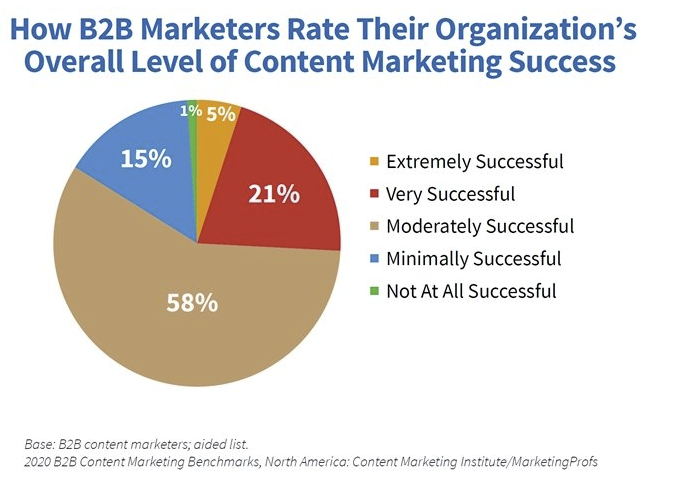
Only 26% of B2B firms feel they are successful in their efforts.
A full 58% report being only moderately successful
16% say they are moderately or not at all successful with their B2B content marketing programs.
These data points prove high adoption and effectiveness aren’t always relative. Use doesn’t equal success. We all know it’s much more complex than that. But how can you get to that point? And what does it mean for the customer journey?
The answer: Successful content marketers map content to the buyer journey!
That’s why we need to start by reframing the B2B content marketing strategy to be buyer-centric.
Becoming Buyer-Centric and Why It Matters
It’s easy to get distracted by the details of your content marketing strategy. Many companies make that mistake. The biggest lesson of all? The star of your content strategy shouldn’t be you. It should be your buyers.
I can’t emphasize this point enough. Content has more legs than engaging buyers before they purchase. It also supports loyalty, retention, and adoption. There’s even more value to communicating after they buy.
If you look at why B2B marketers use content, you’ll find it does cover the full customer life cycle. It must be relevant to where a customer is on her journey. If it’s not, it has little value. It doesn’t mean the content is bad. It’s just not relevant.
In a survey of decision-makers about the content they receive, there were complaints about relevance. Almost 35% of respondents said it lacks personalization to their stage. Another 41% said it isn’t relevant to their companies.
It’s not that you don’t get relevance. It may be a disconnect between your content marketing strategy and audience needs. The good news is that this is fixable!
Mapping More Content To All Buyer Journeys
We have been advocating for years that B2B brands need to reject the choice between quality and quantity in content. Your audience is searching more and consuming more content. And they need help. The buying committee is getting larger. The new entrants are not experts. Basic, foundational, and educational content is the biggest gap.
It is critical in B2B Content Marketing to keep the publishing engine going. It needs to be compelling to your audience. You achieve this by knowing them. Their needs, motives, and demands must influence what you write.
Having this thought process lets you transform. Your strategy becomes audience-centric.
Key Steps to Making Your Strategy Audience-Centric
Factors that impact your content strategy are wide-ranging. But the customer should always be the priority. These steps can help you improve your strategy.
1. Understand user intent in search
Define the buyer stage and “intent” of a customer when searching. Search intent means understanding why someone searched. It’s the question behind the question.
It could be informational, transactional, commercial, or task-oriented. Informational searches seek answers. Transactional describes typing in a brand. Commercial consists of buying language. Task-oriented is specific to an action.
2. Analyze audience behavior
Data matters! To personalize content, analyze how customers interact with it. Take those insights to find the best topics. It also tells you about formats they like.
3. Develop focused buyer personas
I have long believed that personas are great except when they suck. They suck when they don’t inform your content strategy. What questions do your buyers ask? Then map your content to the stages of their purchase journey.
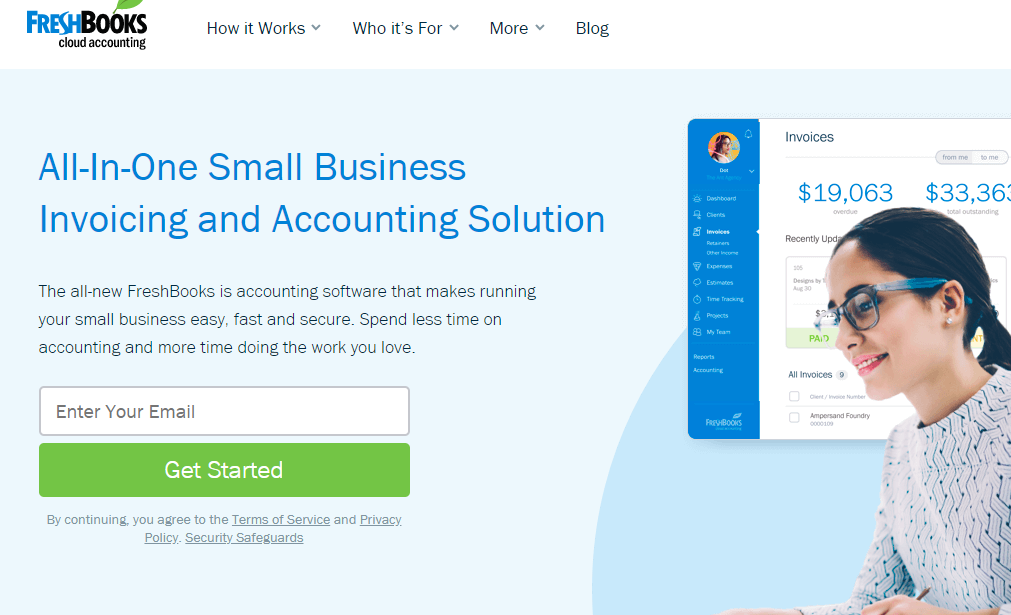
Go in-depth with your personas. Know their world and what matters to them. Narrow it as much as possible. It’s okay to be niche. For example, look at FreshBooks. They provide small business accounting software. When a buyer arrives at their site, they can see it’s a product for them.
4. Listen for buyer signals
Be aware of your customer’s current pain points. To do this, try using marketing tools. Social listening is one option. Creating Google alerts for keywords is another. Finally, pay attention to industry happenings. Do this by subscribing to Reddit threads, or trade and industry group blogs.
5. Keep up with the competition
Competitor analysis tells you a lot. A real lot. Look at the content that’s performing well for them. Find opportunities to use those same topics (and do it better)!
What to Consider Before You Start Mapping Buyer Journeys
You’ll need to do some prep work before mapping. Do this together with your audience-centric strategy. Those exercises you did above inform the next steps.
Collaborate across the company: All customer-facing roles should be in the conversation. They are a source of valuable information. Listen and learn.
Define segmenting: There are many ways to define buyer journeys. There is no “right” way. It depends on your content marketing goals. For example, being role-specific might be helpful. Maybe your audience is healthcare. That’s broad. There are lots of segments here. Being more specific gives you a stronger voice.
Conduct your research: Bring together all your research. Take it further by interviewing buyers and customers. This data allows you to have a 360-degree view of decision-makers.
Assess touch points: Bring your team together to brainstorm about audience engagement. This process includes marketing and non-marketing touchpoints. Peel back the layers to understand interactions. When you do, you can be more strategic.
Set goals: Customer journey mapping is fruitless without objectives. Outline the actions you’d like buyers to take as they move through the life cycle.
Building Your Buyer Journey
Customer journeys are unique. It should be specific to your brand and customers. It’s not a cookie-cutter exercise. In today’s digital world, you may also have multiple buyer journeys. That’s normal. Don’t think you can only have one.
We’ll start with a framework.
The B2B Buyer Journey Map Framework
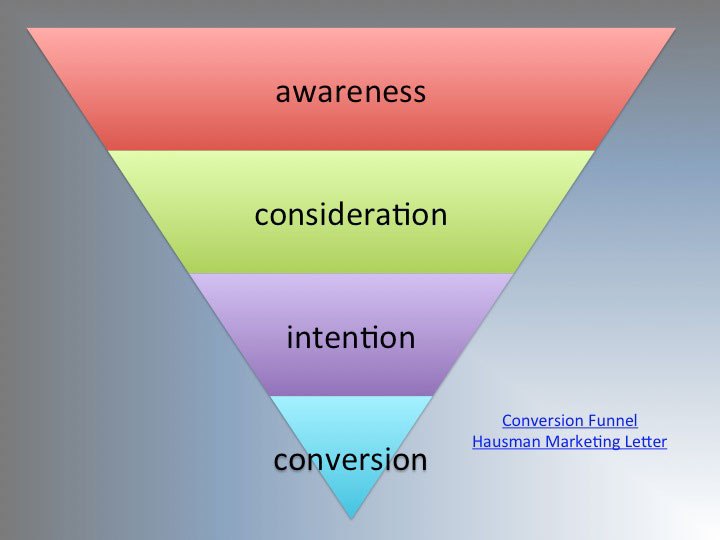
The customer journey should reflect the buyer’s perspective. The major point to keep in mind! This framework guides you to create content for customer journeys. We’ll use the four stages of the conversion funnel. Then also look at the post-conversion journey.
Awareness
Buyer recognizes a need.
This is the broadest stage with the most content.
Introduce solutions and concepts.
Buyers search heavily, so SEO matters.
Consideration
The funnel is narrowing because you’re losing potential buyers.
Focus on solving your buyers’ problems.
Buyers become more aware of your offerings.
Intention
Buyers are deciding which product to buy and comparing possibilities.
Content in this bucket should be persuasive.
Brands must overcome objections.
Peer recommendations are important here.
Conversion
Buyers realize the value of the solution and weigh any risks.
Comfort is a driver of the purchase decision.
Support the conversion by removing any friction or barriers (i.e., making checkout easier).
Retention and Advocacy
After conversion, your content efforts don’t stop. One sale does not make a buyer loyal. You also want them to continue to learn. Learning isn’t only about training. Continue to build their knowledge. Use thought leadership content to do this.
Onboarding is a huge step in the post-conversion journey. Streamline the process and over-communicate. If onboarding goes south, all your hard work will be for naught. Work with onboarding teams to get this right.
Continue supporting their journey to maintain retention, upsell, and engage. Never forget about your current customers. It’s much more expensive to replace an existing customer than attract a new one. Don’t abandon them. Keep building a connection.
Marketing Analytics Support Customer Journey Tracking
Do you know where your audience is within the life cycle? It’s no easy feat. Marketing analytics can help. You know more about each buyer after they become a customer. You can track all their interactions and usage. But what about before they convert? How do you monitor this?
Things to consider in monitoring:
What is the source?
How did the inbound lead come to you? Different sources mean different things. If a buyer completes a form for an awareness-level ebook, they are information-gathering. A buyer that completes a demo form is farther down the funnel.
What content did they consume?
Through cookies and scoring, you can understand their path. These insights are valuable. Use them in producing content for customer journeys. You’ll learn what content makes them act. You’ll also know the formats they like.
How often is engagement?
Buyers that visit often could be warmer. They may be sales-ready. Track engagement across channels. This helps with understanding key touch points.
What are the most important signals?
Look for signals in your marketing analytics. A signal is an action that leads to funnel movement. For example, new content with high traffic tells you it’s popular. Popular means are relevant. Look at what happens after they read it. Do they ask for pricing? Or request a demo? Those are funnel movers.
How are your scoring leads?
Marketing platforms allow you to score visitors. In scoring, you’ll define a marketing inquiry vs. a marketing lead. Assign points to actions. At a certain score, the buyer moves from inquiry to lead. It’s then time for sales to take over.
Content Strategy and Customer Journey Alignment
Your content strategy is your marketing bible. Its purpose is to ensure you share content across the journey. You’re building content from its goals and guidance. Thus, there must be alignment between a content strategy and a customer journey.
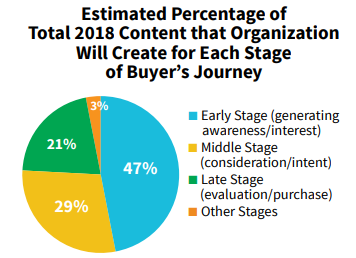
Awareness typically has the most content. According to CMI, nearly half of the efforts go toward early-stage content. This makes sense. It’s content that has to do a lot of work to gain attention.
Early-stage content (awareness)
Early-stage content plays many roles. It establishes credibility. This stage is where you state your case. It’s not blow your own horn. Instead, you’re creating connections. Your content speaks to their challenges.
It also must spur action. This content should generate leads. So, it must have value. If it does, buyers will share their information. Once you have their email, you have a channel for communication you own.
SEO also matters in early-stage content. You have buyers searching for answers. Optimize your content to be the answer to these. High organic rankings bring visibility.
Middle-stage content (consideration and intention)
Middle-stage content keeps the party moving. Buyers are aware. They are aware of you and your competitors. This content needs to be more personal. It needs to express uniqueness.
You’ve made the shortlist. Now it’s time to drive a deeper connection. Focus on how a buyer’s life will change with your product. Let them know what success looks like.
Think case studies and explainer videos. You should address specific decision-makers here. This can change over time. It’s time to nurture. Do so with great content.
Late-stage content (conversion)
Late-stage content pushes buyers to buy. Show the buyer the results of making the purchase. An ROI (return on investment) calculator is an example. Also, empower your internal champion. This person is saying yes. Give them custom content to inform others.
Post-conversion stage content
This content focuses on onboarding and adoption. These topics are first. Content should focus on getting started. It can include guides of the process, training materials, how-to guides, and demo videos.
After this, keep the relationship healthy with useful content. You want to drive loyalty, advocacy, and retention. Use topics like new features, new challenges, and up-selling. Further, this is a chance for your customer to be part of your content. Interview them. Give them praise for what they are doing. Let them tell their story. Advocacy comes from making your customers part of the conversation.
Content for the Customer Journey: Leverage It with Content Experts
Ready to get more traffic to your site with quality content published consistently? Check out our Content Builder Service. Set up a quick consultation now and I’ll throw in a free PDF version of one of my books!
New exploration has uncovered the European nations most dependent via virtual entertainment, with Cyprus beating the competition.
The review, led by gaming site AskGamblers, investigated the most recent accessible use information for Facebook, Instagram and Courier to see which nations had the most noteworthy portion of clients contrasted with the populace.
It observed that Iceland is the European country most dependent via online entertainment, with a score of 98.14 out of 100 for virtual entertainment use. The nation has 327,700 Facebook clients, comparable to 92.6% of the populace. There are additionally 213,100 Instagram clients, around 60.2% of the populace, and 248,900 Courier clients, around 70.3% of the populace.
The Mediterranean island of Cyprus came next on the rundown, scoring 97.97 out of 100 in light of utilization. As of December 2022, the nation has 1,170,400 Facebook clients, which is 93.6% of the populace. There are additionally around 788,000 Instagram clients, 63% of the populace, and 825,300 Courier clients, 66% of the populace.
Coming in third spot is Malta, with a score of 89.71 out of 100 for web-based entertainment utilization. There are 359,900 Facebook clients in the country, which is 80.5% of the populace. Also, the nation has 238,700 Instagram clients, 53.4% of the populace, and 363,900 Courier clients, 69.2% of the populace.
Sweden takes fourth put on the rundown, with a virtual entertainment utilization score of 87.48 out of 100. The nation has 8,754,800 Facebook clients, 84.4% of the populace, and 6,065,400 Instagram clients, 58.6% of the populace. 55.7% of the populace utilizes Courier, with 5,777,500 clients in the country.
Rounding out the top five is Portugal, which comes in with a score of 87.42 out of 100 for social media usage. 8,444,400 Facebook users are in the country, 83.3% of the population. Instagram also has 5,666,600 users in the country, equivalent to around 55.9% of the country and Messenger has 6,024,500 users, 59.4% of the population.
#
Country
Facebook users
% of Facebook users
Instagram users
% of Instagram users
Messenger users
% of Messenger users
Score /100
1
Iceland
327,700
92.6%
213,100
60.2%
248,900
70.3%
98.14
2
Cyprus
1,170,400
93.6%
788,000
63.0%
825,300
66.0%
97.97
3
Malta
359,900
80.5%
238,700
53.4%
309,200
69.2%
89.71
4
Sweden
8,754,800
84.4%
6,065,400
58.6%
5,777,500
55.7%
87.48
5
Portugal
8,444,400
83.3%
5,666,600
55.9%
6,024,500
59.4%
87.42
6
Norway
4,688,300
83.8%
2,906,100
51.9%
3,337,100
59.6%
85.57
7
Denmark
4,915,400
83.6%
2,800,600
47.6%
3,626,100
61.6%
84.15
8
Georgia
3,278,100
84.2%
1,459,000
37.5%
2,728,000
70.1%
83.06
9
Turkey
65,700,000
77.0%
52,364,300
61.4%
34,703,200
40.7%
79.18
10
Montenegro
497,100
79.8%
373,100
51.2%
294,700
47.3%
77.92
Commenting on the findings, a spokesperson for AskGamblers, said: “It’s interesting that information on usage data for some of the biggest social media sites is readily available nowadays. However, it’s good to have, as it highlights how much the residents of certain countries rely on and use social media in their daily lives. Further expansion of the study may also highlight the divide in internet usage in the Western world.”