Blog

  • 81% of advertising groups would have more occasions with the right apparatuses

    81% of advertising groups would have more occasions with the right apparatuses

    Monetary headwinds, changing B2B purchasing ways of behaving, and less assets are a portion of the basic difficulties confronting occasion specialists in 2023, as per the third yearly Occasions Standpoint Report from Sprinkle, an occasion showcasing innovation organization that serves venture organizations and their occasion, promoting and outreach groups around the world.

    The review of 670 occasion advertisers and experts in North America, Europe, and the UK, directed in late 2022, found that in spite of 85% of occasion advertisers detailing an expansion in their spending plans for 2023, they keep on feeling frustrated by their absence of assets – both human and monetary – and the requirement for innovation that better backings their jobs and assists them with further developing efficiencies.

    Those imperatives, combined with an undeniably advanced and complex purchaser venture and the need to demonstrate occasions’ effect on the main concern, drive more occasion advertisers to explore different avenues regarding different occasion designs. The regular occasion – an occasion intended to be duplicated on numerous occasions across locales, verticals, designs (virtual/cross breed/face to face), and partners – is on the psyche of something like 33% of advertisers who are pulling together their techniques around these more continuous, adaptable occasions over leader occasions, like meetings and tradeshows.

    With a psyche to upgrading financial plans and accomplishing more with less, occasion advertisers are utilizing the ordinary occasion configuration to habitually slice through the clamor of stuffed and unknown encounters and contact their crowds more.

    Kate Hammitt, CMO of Sprinkle, said: “The most recent three years have shown that occasion experts are a strong gathering, staying lithe and trying different things with various chances to drive income through occasions.

    “Our most recent exploration shows that occasion advertisers are, indeed, changing their methodologies to make more association focuses with participants and emphatically influencing return for capital invested. Furthermore, we’re proceeding to see proof that ordinary occasions – at scale – can drive critical monetary effect on an organization’s deals pipeline all year.”

    Occasions and experiential projects are essential parts of an organization’s promoting blend. However, the fruitful execution of occasions, particularly at scale, can be requesting because of restricted assets, manual cycles, and tangled innovation arrangements. Advertisers need innovation that makes it more straightforward to make, make due, measure, and reproduce occasions and guarantee those occasions stay on-brand and connect with their interest groups.

    The 2023 Occasions Viewpoint Report shows that 81% of occasion professionals would hold more occasions assuming they had the right instruments. Other report discoveries show that:

    Ordinary occasions demonstrate their value: Almost 33% (27%) of occasion advertisers intend to have 11-20 of these occasion types.
    Undiscovered income potential: With most of occasions (84%) focusing on existing clients, there’s a huge chance to extend occasion projects to get new purchasers. Considerably less than half (41%) of occasions are aimed at the planned purchaser – showing a noteworthy potential for development!
    Virtual occasions are as yet an oddity: while only 6% of occasion advertisers have just virtual occasions now, 38% say they are financially savvy.
    Interest in occasion tech remained generally unaltered from 2021, with half (53%) of occasion advertisers saying their tech spending plans remained something similar.
    The occasion blend is evolving: huge “leader” occasions aren’t disappearing, however just 13% of advertisers say they’re zeroing in on them in 2023. All things being equal, more advertisers are taking a gander at regular occasions to arrive at their interest group at numerous touchpoints consistently
    Measurements matter: thus does having the right participants; 32% of advertisers say this is their generally significant measurement to quantify outcome in 2023, up 6% from 2022.
    Occasion innovation keeps on being a focal part of showcasing methodologies in 2023, with 81% of occasion advertisers searching for assets that can assist them with boosting their occasions’ true capacity and drive incomes. Occasion experts today are in an optimal situation to try and learn with the accessibility of adaptable apparatuses that empower them to increase or down as per steadily changing business objectives. Testing different occasion designs assist with revealing what resounds best with crowds, developing their association while driving new learning experiences.

  • The Rise of Voice Search

    The Rise of Voice Search

    Voice search has taken the world by storm in recent years. In fact, it has become so popular that it’s now a standard feature on most modern devices, including smartphones, smart speakers, and even cars. As technology continues to evolve, more and more people are turning to voice search to find the information quickly and easily they need.

    But what exactly is voice search, and why has it become so popular?

    What is Voice Search?

    Voice search is a technology that allows users to perform a search query on a device using voice commands instead of typing. It is powered by artificial intelligence and machine learning algorithms that interpret spoken language and return relevant results.

    Voice search technology has been around for decades, but it wasn’t until the introduction of personal assistants like Siri and Google Assistant that it really took off. Today, these assistants are built into most modern devices, making it easy for users to access voice search with just a few words.

    Why has Voice Search Become So Popular?

    There are a few reasons why voice search has become so popular in recent years. One of the biggest is the rise of mobile devices. With more and more people using smartphones to access the internet, it’s no surprise that they are turning to voice search as a more convenient and efficient way to find the information they need.

    Another factor is the increased accuracy of voice search technology. Thanks to advancements in natural language processing and machine learning, voice search has become much more accurate and reliable in recent years. This has made it a more viable alternative to traditional search methods, which often require users to sift through pages of search results.

    Finally, voice search has also become more popular due to the rise of smart speakers like Amazon Echo and Google Home. These devices have made it easy for people to use voice search in their homes and have created a new market for voice-activated technology.

    The Benefits of Voice Search

    There are several benefits to using voice search. First and foremost, it’s a more convenient and efficient way to search for information. With just a few words, users can quickly access the information they need, without having to type out a query.

    Voice search is also ideal for people who are on the go, as it allows them to search for information while driving, walking, or doing other tasks. It’s also a great option for people who have disabilities or who have difficulty typing on a keyboard.

    Finally, voice search can also be a more accurate way to search for information. By interpreting natural language, voice search can often return more relevant results than traditional search methods, which rely on specific keywords.

    The Future of Voice Search

    As technology continues to evolve, it’s likely that voice search will become even more popular and widespread. In fact, some experts predict that voice search could eventually overtake traditional search methods altogether.

    To prepare for this future, businesses and website owners should start optimizing their content for voice search. This means using conversational language and natural phrasing, as well as focusing on long-tail keywords and answering questions directly.

    In conclusion, voice search has become a powerful tool for people around the world. Thanks to its convenience, efficiency, and accuracy, it has quickly become a popular alternative to traditional search methods. As technology continues to advance, it’s likely that voice search will only continue to grow in popularity, making it an essential part of any digital strategy.

  • Winning at Marketing’s in 2023 Market Wavegens Surveyed Marketing Qualified Leads Unveiled

    Winning at Marketing’s in 2023 Market Wavegens Surveyed Marketing Qualified Leads Unveiled

    In today’s business landscape, companies are competing more than ever before. In this highly competitive environment, it is crucial to have a strong marketing strategy to attract and retain
    customers. Market Wavegen is a marketing solutions provider that specializes in demand generation, lead nurturing, and lead conversion.

    Our unique approach combines market intelligence, creative insights, unconventional tactics, and a multi-channel perspective to help agencies, publishers, and enterprises improve their marketing strategies and achieve their business goals.

    Understanding the Importance of Target Audience

    To develop an effective marketing strategy, it is essential to understand your target audience. The more you know about your customers’ needs, preferences, and behaviour, the better you can tailor your marketing strategies to meet their needs. That is why Market Wavegen has developed the Surveyed Marketing Qualified Leads program.

    This program provides deep insights into your target audience, helping you gain a better understanding of your customers’ needs and preferences, and tailor your marketing strategies accordingly.

  • The Impact of 5G on Digital Marketing: A Game Changer for Marketers

    The Impact of 5G on Digital Marketing: A Game Changer for Marketers

    The rollout of 5G networks is set to revolutionize the digital landscape and transform the way we do business. With faster download and upload speeds, lower latency, and greater bandwidth, 5G promises to usher in a new era of connectivity, innovation, and growth. One of the areas that will be significantly impacted by 5G is digital marketing. In this blog post, we will explore the impact of 5G on digital marketing and how marketers can leverage this technology to enhance their strategies and stay ahead of the competition.

    Faster Speeds and Lower Latency

    One of the most significant advantages of 5G is its faster download and upload speeds. With 5G, users can download and upload content at lightning-fast speeds, allowing them to access and share information more quickly and efficiently. This means that marketers can deliver content to their target audience faster than ever before, reducing the time it takes for users to access their content and improving the overall user experience. In addition, 5G networks have lower latency than their predecessors, which means that data can be transmitted more quickly and efficiently. This will enable marketers to deliver real-time marketing campaigns that are more responsive to user behavior and preferences. For example, marketers can use 5G to deliver personalized content to users based on their location, interests, and past behavior.

    Greater Bandwidth

    5G networks also offer greater bandwidth, which means that more devices can be connected to the network simultaneously. This will allow marketers to leverage the Internet of Things (IoT) to deliver more targeted and personalized marketing campaigns. For example, marketers can use 5G to connect with users’ smart devices and deliver targeted ads and promotions based on their behavior and preferences.

    Enhanced User Experience

    With faster speeds, lower latency, and greater bandwidth, 5G promises to enhance the overall user experience, making it easier and more enjoyable for users to engage with digital content. This will enable marketers to create more immersive and engaging content, such as augmented and virtual reality experiences, that can be delivered in real time and at a higher resolution.

    In addition, 5G networks will enable marketers to leverage emerging technologies such as artificial intelligence and machine learning to analyze user behaviour and deliver more personalized and targeted marketing campaigns. For example, marketers can use 5G to analyze user data in real time and deliver personalized recommendations and offers based on their interests and preferences.

    Challenges and Opportunities

    While 5G offers many opportunities for marketers, it also presents several challenges. One of the main challenges is the need for marketers to adapt their strategies to new technology. This will require marketers to invest in new technologies and tools to take advantage of the new capabilities offered by 5G.

    In addition, the rollout of 5G is still in its early stages, with coverage still limited in many areas. This means that marketers will need to be strategic in their approach, focusing their efforts on areas where 5G coverage is strongest and building partnerships with telecom providers to ensure their content is delivered efficiently.

    Conclusion In conclusion, the impact of 5G on digital marketing is set to be profound, enabling marketers to deliver more immersive and engaging content, analyze user data more effectively, and create more personalized and targeted marketing campaigns. While there are challenges to be overcome, marketers who invest in new technologies and adapt their strategies to take advantage of 5G will be well-positioned to stay ahead of the competition and succeed in the new era of connectivity and innovation.

  • Why LinkedIn Actually Positions #1 for B2B Advertisers

    Why LinkedIn Actually Positions #1 for B2B Advertisers

    LinkedIn has consistently held an exceptional spot in the hearts of B2B advertisers, and the figure for 2023 shows we can anticipate that it should remain famous this year. Pursuing directions from earlier years, LinkedIn stays the top virtual entertainment channel for commitment among B2B advertisers.

    Our latest Sagefrog B2B Showcasing Blend Report inspecting promoting patterns for the year ahead found that of the B2B advertising experts overviewed, 41% will depend on LinkedIn advertisements as their organizations’ most-utilized virtual entertainment strategy. Facebook advertisements started to lead the pack this year at 55%, however natural and supported social posts — remembering those for LinkedIn, as well as different stages — were at 46% and 44%, separately.

    Investigate the top showcasing choices LinkedIn offers B2B advertisers, which have driven web-based entertainment to divert past the brink with regard to commitment, open rates, and lead age.

    2023 Marketing Mix Social Engagement

    LinkedIn Ads

    In LinkedIn’s own words, it helps people “do business where business gets done,” and that’s undoubtedly true for marketers who have used the platform for networking and lead generation. LinkedIn provides various tools that allow marketers to quickly develop and launch effective ads without spending tons of money.

    B2B marketers are looking to increase sales leads and convert those leads into customers, and the platform’s highly focused targeting capabilities accelerate that process.

    As marketers dial in their personas, they can optimize their ads based on traits like job titles, company names, industries, professional interests, personal interests, and more. LinkedIn’s term for ads is Sponsored Content, and it comes in a variety of sizes and formats, including:

    Single Image Ads
    Video Ads
    Carousel Ads
    Text Ads
    Follower Ads
    Spotlight Ads
    Job Ads
    Content Ads
    This flexibility offers content and creative strategists an inspiring range of possibilities to work with for designing exciting ads that connect with your ideal customers.

    LinkedIn Sponsored Messaging Ads (Formerly InMail)
    Typically, you have to approve a connection to another user on LinkedIn before you can send each other direct messages. Versions of this restriction exist on other social media platforms as well, but LinkedIn Sponsored Messaging allows you to sidestep that barrier to connect directly with business professionals.

    Sponsored Message Ads on LinkedIn let B2B marketers craft brief, clear messages to the exact people they need to address while avoiding the look, feel, and approach of standard ads that would appear normally in the user’s feed. They’re a traditional ABM approach that still thrive on the digital marketing scene, with more than 1 in 2 prospects opening up a Message Ad, according to LinkedIn.

    The best Message Ads are conversational and personalized to make people more receptive to the information you’re sharing. They give recipients a sense that there’s a real person on the other end, which can be infinitely more effective in building trust and engagement than traditional digital ads.

    Throughout the pandemic, this tactic has also been vital in promoting the tsunami of webinars and video conferences that have taken over the professional world. It has allowed marketers to get the message out directly to their highest-priority contacts with highly personalized invitations, dramatically boosting attendance.

    LinkedIn Pages
    According to LinkedIn, a LinkedIn Page is “your place in the world’s professional community.” By creating a page for your business and connecting with your leads, clients, and colleagues, you can engage with your audience and create strong brand awareness.

    Slightly different from a personal LinkedIn page, your company page offers unique features, such as a call-to-action (CTA) button that can be customized to draw a crowd to your website or another link for your business. You can also post long-form content from your account that will live on the page’s feed, which can be useful for sharing thought leadership and content marketing assets with your audience.

    LinkedIn Learning
    As B2B marketers, we know our education is never complete. There are always new things to learn and new best practices to implement in our professional repertoire. While it isn’t quite a marketing tool on its own, LinkedIn’s educational portal—LinkedIn Learning—is a valuable asset for improving your marketing campaigns.

    LinkedIn Learning offers online courses on topics in business, professional development, specific industry skills, and more. The courses are all led by experts in each subject area. So when you consider the options that LinkedIn offers marketers, don’t forget about the benefits of expanding your knowledge base.

    LinkedIn Talent Solutions
    When you’re looking to expand your team, it’s always great to have a reliable place to start. That’s where LinkedIn Talent Solutions comes in. B2B’s favorite social media platform—the one that can post organic content and ads, offer customizable pages, and even has training opportunities in your field—also has tools for finding your next star employee.

    You can post a job opening on LinkedIn and find candidates that match what you need, both within your existing professional network and outside of your current search radius. Just like with LinkedIn Ads, you set the budget you want and move forward from there.

    Start Generating More Leads With LinkedIn
    Whether you’re beginning a new campaign, re-strategizing an existing campaign, looking into LinkedIn Stories, or simply searching for more ways to generate more leads on LinkedIn, it’s clear that LinkedIn is your best social bet.

    LinkedIn allows for multiple organic ways to generate interest from your target audience. Sharing updates, posting articles or stories, liking and commenting on other people’s posts, are all great ways to just organically get your name out there. Heck, I found just connecting with people in an authentic way is a great way to get in front of potential clients.

    However, with so much spam on LinkedIn, it’s important not to SELL on the platform or in your messages. When sending a connection request, do NOT bring up your company or use some form response. Use something personal or a common connection who you actually both know.

    Another way I love to use LinkedIn for leads it to use it as a platform for easy employee activation. Get your employees to connect with others, post content, like other people’s posts and comment.

  • Enhancing Content Advancement Channels To Expand Change Rates

    Enhancing Content Advancement Channels To Expand Change Rates

    Content promoting is an incredible asset for driving brand mindfulness, leads, and deals.

    Nonetheless, making excellent substance is just around 50% of the fight. To see genuine outcomes, you want to elevate that substance to your main interest group actually.

    There are endless channels accessible for advancing your substance, from web-based entertainment and email promoting to paid publicizing and powerhouse organizations. In any case, with so many choices, it tends to be hard to tell where to concentrate your endeavors.

    In this post, we’ll explore some of the most effective ways to promote your content and provide actionable tips for optimizing each channel.

    Quick Takeaways:

    • Integrating your efforts across paid, owned, and earned channels is the most effective approach to optimizing content promotion
    • Testing and picking the best content to promote is significantly more effective than pushing content manually chosen
    • Search and email provide the best reach and conversion for most brands
    • But testing what works for you is the most important takeaway from our research

    Integrated (or Converged) Marketing Channels

    We’ve been talking about the term integrated marketing for a very long time. But what does it really mean?

    For many brands, integrated marketing has meant making someone or some team responsible for the distribution of content vs creation. In some organizations, this included campaign content. In others, it really just refers to paid media.

    So the execution and promise of integrated marketing often fall short because of this lack of clarity. So let’s set the record straight:

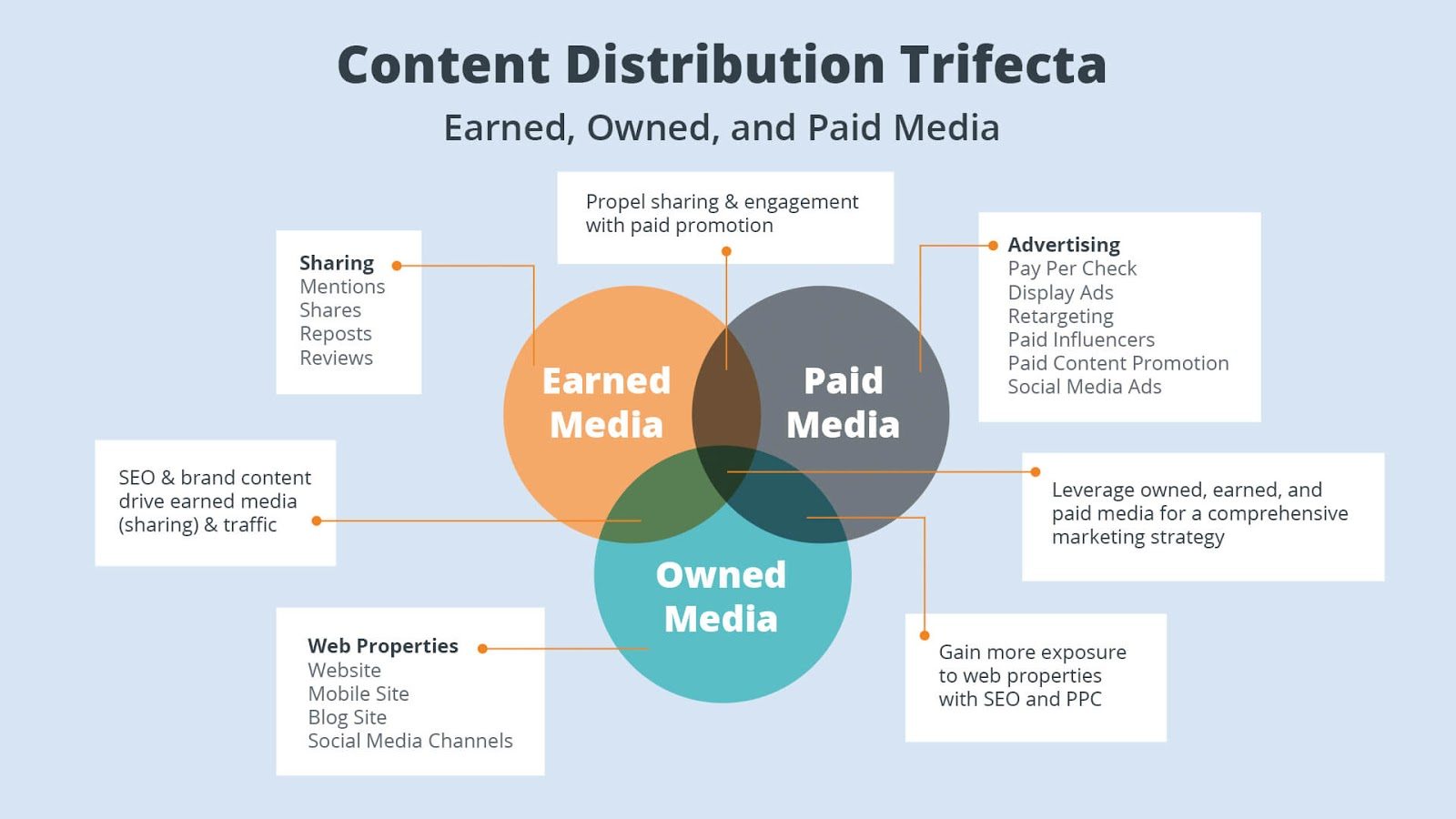
    Integrated marketing means looking across the various elements of paid, owned, and earned media, to ensure the most efficient and effective creation and distribution of content to achieve reach, engagement, and conversion of new customers.

    In more simple terms, I have said that integrated marketing should allow you to:

    • Get found
    • Get shared
    • Get leads

    Converged media, then is really just another name for an effective content marketing strategy that leverages all paid, earned, and owned media to achieve the best results across the buyer journey or marketing funnel.

    What is Content Marketing? - Instapage Marketing Guide

    Methods For Optimizing Content for Promotion

    Before we look at the best channels for content promotion, we need to consider the best practices in content promotion:

    1. Identify your best-performing content: Before you begin promoting your content, take some time to analyze which pieces are already performing well. Look at metrics such as website traffic, engagement, and conversions to determine which content is resonating with your audience. Once you have a sense of what is working, you can focus your promotion efforts on those pieces.

    2. Pick the right time to promote: Timing is everything when it comes to content promotion. Consider the best time to post on social media, send out emails, or run paid advertising campaigns based on when your audience is most active and engaged. Use tools such as Google Analytics to understand your audience’s behavior, and schedule your promotion accordingly.

    The Best Times to Post on Social Media in 2022 | Sprout Social

    3. Repurpose and republish content: Don’t let your older content go to waste. Repurpose and republish your best-performing content on different platforms to reach new audiences. You can also update old content with new information, images, or videos to give it a fresh look and make it relevant again.

    4. Use visuals: Visuals can help your content stand out on social media and other platforms. Use images, GIFs, and videos to make your content more engaging and shareable.

    5. Create a content calendar: To ensure that your content promotion efforts are consistent and effective, create a content promotion calendar. This will help you plan and schedule your content promotion in advance, so you can stay organized and on track.

    6. Use paid promotion selectively: While paid promotion can be a great way to boost visibility, it’s important to use it selectively. Not all content will perform well with paid promotion, so be sure to test different pieces to see which ones are most effective.

    7. Track and measure your results: Finally, it’s important to track and measure your results to understand what is working and what isn’t. Use tools such as Google Analytics, social media analytics, and email marketing software to measure the success of your content promotion efforts.

    By following these tips, you can effectively promote your content and reach your target audience. Remember to be the consistent, test and measure your results, and optimize your content over time for maximum reach and engagement.

    Which Content Promotion Channels Are Most Effective?

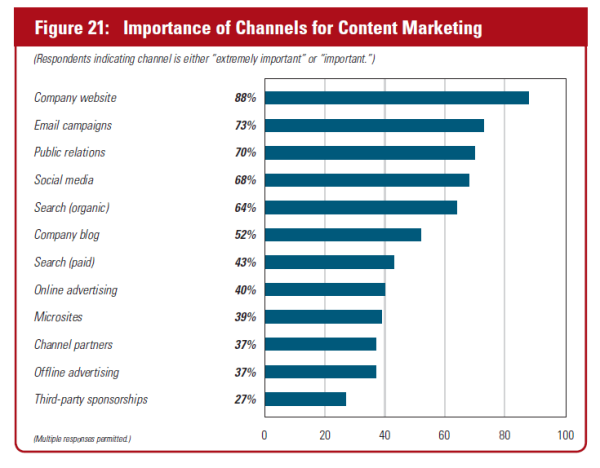
    So which channels are most effective at promoting your content? Well, of course, the answer is “it depends” on many factors. For the majority of companies, focusing on your own website seems to be a good first place to start, followed by email.

    Survey: 46% Of Marketers Have Content Marketing Strategy, Only 25% Track Social Media Results
    Source: MarketingCharts

    Let’s take a look at some of these channels in a bit more depth:

    1. Your Website: In my definition of content marketing, it doesn’t count if you don’t publish it on your website. The main reason is that this is where you want to attract new prospects through organic search and SEO. It is also more measurable than most channels. (It’s also why we exist!) So don’t forget to optimize your content for search engines. Use keywords in your content, meta tags and descriptions, and internal and external links to boost your content’s visibility on search engine results pages.

    2. Email Marketing: Email marketing is a highly effective way to reach your existing audience and promote your content. Personalize your subject lines to increase open rates and segment your email list to ensure that your content is reaching the right people. Use A/B testing to determine the most effective subject lines, calls to action, and sending time for your audience.

    3. Social Media: Social media is a great way to reach a large, engaged audience. However, it’s important to choose the right platforms for your brand and target audience. For example, if your target audience is primarily B2B, LinkedIn may be a better choice than Instagram. Once you’ve identified the right platforms, make sure to optimize your content for each channel by using the appropriate format and hashtags.

    4. Paid Advertising: Paid advertising can be a great way to quickly boost visibility for your content. Consider using platforms like Facebook Ads, Google AdWords, and LinkedIn Ads to reach your target audience. Be sure to set clear goals and track your results to optimize your campaigns over time.

    5. Influencer Marketing: Influencer marketing can be a great way to reach a new audience and boost credibility for your brand by tapping into the influence of others. Identify influencers in your industry who have a following that aligns with your target audience (we use Buzzsumo), and work with them to create sponsored content that features your brand and products.

    6. Employee Advocacy: Ok so this is my secret weapon tip and it’s the main reason why we were so successful at building success at SAP. We built an army of writers and employees willing to promote our content on their own social platforms. Our first 100 or so email subscribers were salespeople who used our content to sell on LinkedIn.

    Which Sources Actually Deliver The Most Impact?

    I have looked for this data for hours! Turns out that no matter which source you find (Hubspot, Alexa, etc) the answer is pretty clear:

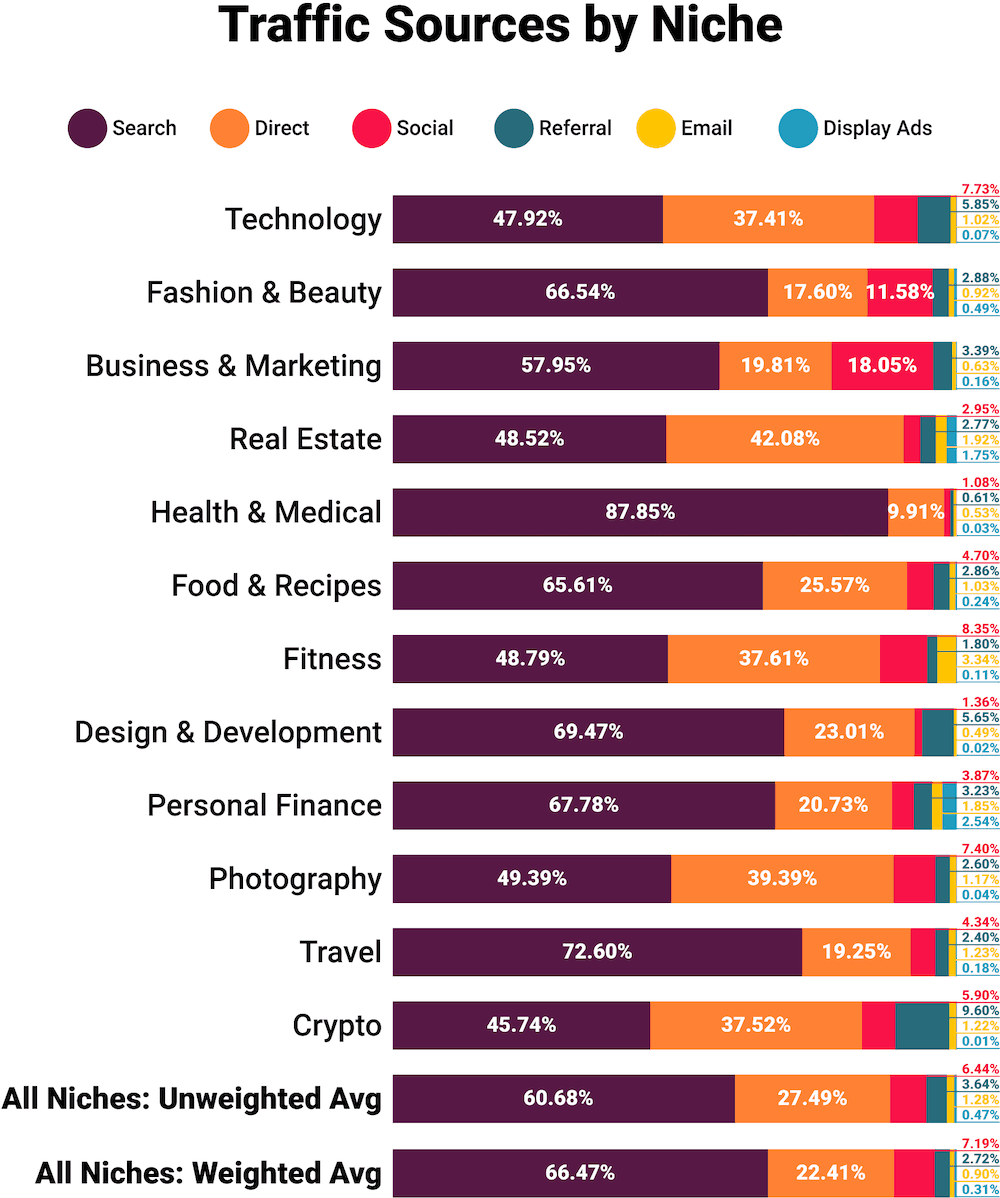
    80-90% of website traffic comes from organic search and people finding their way to your website directly.

    Social only accounts for 4-6% on average and less than 5% in most B2B Companies. And paid traffic accounts for less than 0.5% of traffic!

    All the more reason to focus on content marketing to generate the most traffic and leads!

    Chart comparing traffic sources by niche

    Some Other Promotion Channels

    While the aforementioned channels are the main staples of your promotion strategy, there are some different, more niche places for you to post your content. Try them out and note which ones work and which don’t:

    • Post a thread on www.inbound.org
    • Find a relevant Reddit thread
    • Look for a Slack community about your topic or industry
    • Post your product/tool on Product Hunt
    • Create a Snapchat story with tips about your content, then include a link for viewers to screenshot (we recommend a bit.ly!)
    • Post on Instagram with a link to your content in your bio

    Once you get your engine up and running, you can optimize for conversion and increase leads without creating any new content!

    In conclusion, promoting your content is just as important as creating it. By using a variety of channels, you can reach your target audience and drive engagement. Remember to track your results and optimize your campaigns over time for maximum reach and engagement.

  • Driving Results and Building Relationships: The Power of Personalization in B2B Marketing

    Driving Results and Building Relationships: The Power of Personalization in B2B Marketing

    In today’s hyper-connected world, B2B marketing has become an increasingly complex and competitive space. With so many businesses vying for the attention of their target audience, it’s essential for B2B marketers to find ways to stand out and make an impact. One of the most effective ways to achieve this is through personalization.

    Personalization in B2B marketing is the practice of tailoring your marketing efforts to the specific needs and preferences of individual prospects and customers. This can be done through a variety of methods, including targeted content, personalized emails, and customized landing pages.

    There are a few powerful benefits to incorporating personalization into your B2B marketing strategy. Here are just a few:

    Improved Customer Engagement: Personalization allows you to connect with your customers on a deeper level, by showing that you understand their unique challenges and needs. By tailoring your marketing efforts to their specific interests, you’re more likely to capture their attention and keep them engaged with your brand.

    Increased Conversion Rates: When you tailor your marketing efforts to the specific needs of your customers, you’re more likely to provide them with the information they need to make a purchasing decision. This can lead to increased conversion rates, as well as higher customer satisfaction and loyalty.

    Enhanced Brand Reputation: By demonstrating that you understand and care about your customers, you can build a stronger reputation as a trusted and customer-focused brand. This can help you stand out in a crowded market and attract new customers to your business.

    Better Data Collection: Personalization can also help you collect more accurate and useful data about your customers. By tracking their behaviours and preferences, you can gain insights that will help you refine your marketing efforts and provide a better customer experience.

    There are many ways to incorporate personalization into your B2B marketing strategy. Here are a few examples:

    Targeted Content: By creating content that addresses the specific challenges and needs of your customers, you can capture their attention and keep them engaged with your brand. This might include blog posts, whitepapers, or case studies that highlight the ways your products or services can help them solve their problems.

    Personalized Emails: By sending personalized emails to your customers, you can show them that you understand their needs and are committed to providing them with the information they need to succeed. This might include targeted offers, customized messaging, or personalized product recommendations.

    Customized Landing Pages: By creating landing pages that are tailored to the specific needs and interests of your customers, you can provide them with a more relevant and engaging experience. This might include personalized messaging, targeted offers, or customized calls to action. Overall, the power of personalization in B2B marketing cannot be overstated. By taking the time to understand the unique needs and preferences of your customers, you can create more effective marketing campaigns that drive engagement, conversion, and customer loyalty. So, if you’re looking to stand out in a crowded market, consider incorporating personalization into your B2B marketing strategy today.

  • Do You Want a Brand Informing Structure?

    Do You Want a Brand Informing Structure?

    Whether you’re doing a brand revive or sending off another mission, a strong brand-informing structure is fundamental for progress. Scaling your business requires a reasonable vision for your image, and a bunch of informing rules smoothes out your thoughts.

    At the point when there’s a consistent brand informing system set up, speedy things to do are not difficult to finish. Imparting your image’s main goal to potential clients becomes easy. Here’s the reason your image-informing structure is significant and the way in which you can begin with only 3 simple.

    Quick Takeaways

    • Consumers typically have 5-7 brand interactions before they remember a brand 
    • Both your audience and employees will benefit from a streamlined messaging framework, as your brand’s identity and story will be more clearly defined
    • B2B customers complete 70% of the buyer’s journey without speaking to a sales representative 
    • Cohesive branding across all teams and channels increases revenue by 23%

    Effective messaging shares your brand’s mission and helps both team members and potential customers understand the value of your business. A brand messaging framework ensures effective, consistent, and meaningful messaging.

    What Is A Brand Messaging Framework?

    A brand messaging framework is a structured communication of how your brand’s value and identity differ from the competition. A successful messaging framework represents your business’s unique selling points and is easy for both customers and team members to understand.

    B2B customers complete 70% of the buyer’s journey without speaking to a sales representative. A messaging framework ensures that consumers gain an accurate understanding of your brand while completing their own research. It also aligns messaging between different teams within your company, ultimately aiding in closing more deals, more efficiently.

    infographic show how a brand messaging framework streamlines messages

    Image Source: Marketing Profs

    Your messaging framework acts as the foundation for building your business’s functions:

    • Marketing & Advertising. Value propositions and core messaging need to be consistent to be effective. A set of messaging guidelines ensures that marketing and advertising teams adhere to the same principles.
    • Communications. A messaging framework will help your communications team highlight key points in the company’s strategy, values, and goals.
    • Sales. Sales teams need a solid messaging framework to define the language used while communicating with customers. This helps set your products and services apart from the competition.
    • Content Creators. Content creation needs to be consistent across all platforms. Brand messaging frameworks keep blogs, podcasts, videos, and other content aligned.
    • Public Relations. Your public relations team needs a complete understanding of your brand to uphold its reputation. This can be obtained through a brand messaging framework.
    • Human Resources. A streamlined messaging framework helps Human Resources to create consistency in employee training, onboarding materials, and job descriptions.

    Both your audience and employees will benefit from a streamlined messaging framework, as your brand’s identity and story will be more clearly defined.

    Why Is A Brand Messaging Framework Important?

    Did you know that consumers typically have 5-7 brand interactions before they remember a brand? That’s why keeping your messaging memorable with established guidelines is key to attracting potential buyers.

    Developing a brand messaging framework also communicates your brand story and develops trust between your business and your customers. Established trust plays a major role in consumer decision-making.

    image shows that 58% of customers choose a brand over competitors when there is trust

    Other benefits of establishing a primary brand messaging framework include:

    • Word-of-mouth marketing. Word-of-mouth marketing has reigned supreme for years because people buy what their friends and family recommend. Messaging guidelines help create an emotional connection with consumers and encourage them to talk to others about your brand.
    • Consistency. When it comes to marketing, consistency is key. In fact, cohesive branding increases revenue by 23%. Consistent messaging, design, products, and content will also highlight your brand’s core values and resonate with your target audience.
    • Unique brand identity. Customers want to engage with a brand that has a clear identity. A brand messaging framework lets your audience know what your organization represents so they know what to expect from your business.
    • Organized messaging. Whether you’re redesigning your homepage or creating your blog content calendar, a clear set of guidelines for messaging helps you and your team stay on brand.

    In a nutshell, a brand messaging framework is important because it aligns your content and strengthens your brand’s voice in the marketplace. It makes your content memorable and easy-to-understand and enhances your brand’s identity.

    3 Most Important Components of a Messaging Framework

    Before building your brand messaging framework, there are 3 components that need to be clearly defined and understood.

    1. Target Audience

    A solid understanding of your target audience is key to reaching them through your brand’s messaging. If you haven’t already clearly defined your audience, start by asking yourself the following questions:

    • Where do they live?
    • How old are they?
    • What is their relationship status?
    • How much money do they earn?
    • What problems do they need solved?

    Keeping your company’s communication professional and well-written means first nailing down the demographics and needs of your target audience.

    2. Value Proposition

    Your brand’s value proposition is also its first impression– and as you know, first impressions are everything. A business’s value proposition demonstrates how your company differs from the competition and gives a general overview of what your brand has to offer. It’s also persuasive and optimized for conversion.

    While perfecting your value proposition, keep in mind your audience’s identity, problems, needs and available alternatives to ensure effectiveness. Addressing your audience’s concerns will make them more likely to continue learning about your brand.

    3. Positioning Statement

    After identifying your value proposition, it’s time to define your brand positioning statement. A bit more broad than your value proposition, its purpose is to show potential buyers why they need your products or services.

    A successful positioning statement addresses how your products compete with similar brands and how they make a positive impact on your customers. As always, leading with empathy and transparency will help enhance your statement’s effectiveness.

  • Revolutionize Your Lead Generation with Market Wavegen’s SMQLs

    Revolutionize Your Lead Generation with Market Wavegen’s SMQLs

    Market Wavegen’s Surveyed Marketing Qualified Leads (SMQLs) are an innovative solution for addressing the challenges faced with Marketing Qualified Leads (MQLs) in 2023. MQLs are an essential aspect of any marketing strategy, but there are three common challenges that companies face when working with these leads. In this blog, we will explore how SMQLs can help address these challenges and provide companies with a more effective lead generation and conversion process.

  • Maximize Your Lead Generation in 2023 with Market Wavegen’s Quality SMQLs

    Maximize Your Lead Generation in 2023 with Market Wavegen’s Quality SMQLs

    In today’s competitive business world, generating leads is crucial for any company’s success. However, not all leads are created equal. Market Wavegen, a leading provider of survey marketing and lead generation services, has established a reputation for delivering consistent quality leads that help companies grow their businesses. In this blog, we will explore how Market Wavegen’s approach to lead generation can benefit companies in 2023.

    Surveyed Marketing Qualified Leads

    One of Market Wavegen’s unique offerings is its survey marketing approach. This strategy involves conducting surveys to gather data from potential customers about their needs, interests, and buying behavior. The results of these surveys can then be used to create highly targeted and effective lead-generation campaigns.

    By using surveyed data to create targeted campaigns, Market Wavegen is able to deliver leads that are more likely to convert into sales. These leads, known as Surveyed Marketing Qualified Leads (SMQLs), have already demonstrated interest in a company’s products or services and are more likely to become paying customers.

    Consistent Quality Leads

    Market Wavegen’s commitment to quality extends beyond just its survey marketing approach. They have developed a proven process for lead & demand generation that helps ensure consistent quality results. This process involves using advanced technology, such as artificial intelligence and machine learning, to analyze large amounts of data and identify the most promising leads. Market Wavegen’s team of experienced lead generation specialists then follows up with each lead to verify their interest and gather additional information.

    By consistently delivering quality leads, Market Wavegen helps companies avoid the frustration and waste of time associated with pursuing low-quality leads. With Market Wavegen’s help, companies can focus their resources on leads that are most likely to convert into sales, increasing the efficiency of their lead-generation efforts and driving their businesses forward.

    Leveraging Market Wavegen’s Product and Services

    In 2023, companies that are looking to grow their businesses and generate more leads should consider partnering with Market Wavegen. Their unique survey marketing approach, combined with their commitment to delivering consistent quality leads, makes them an ideal partner for companies looking to generate leads and grow their business.

    In addition to their lead generation services, Market Wavegen also offers a range of tools and resources to help companies make the most of their lead generation efforts. These tools include lead tracking and management tools, as well as analytics and reporting tools that help companies understand their lead generation results and make informed decisions about how to improve their efforts.

    In conclusion, Market Wavegen is a consistent source of quality leads in 2023. By leveraging their SMQLs and lead generation services, companies can improve their lead & demand generation efforts and grow their businesses. If you’re looking for a partner to help you generate leads and grow your business in 2023, consider Market Wavegen.