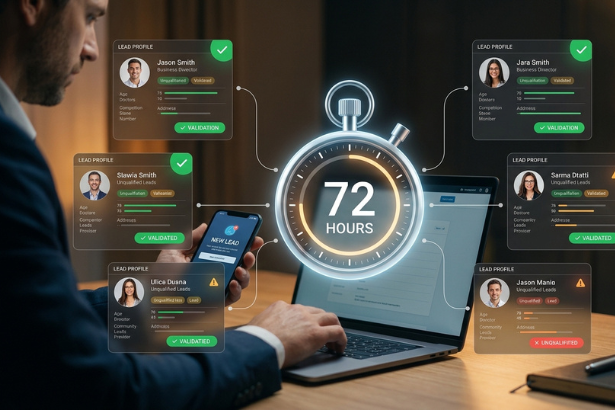
First 72 hours after lead capture determine pipeline success. Learn how to validate, qualify, and convert leads faster with signal-first systems.
The moment pipeline is won or lost
The first 72 hours after lead capture are where pipeline is either created or quietly destroyed. Most B2B teams assume conversion is a long game. In reality, timing is the deciding factor.
A prospect who downloads a report today is not the same buyer three days later. Priorities shift. urgency fades. competitors enter the picture.
This article breaks down why those first 72 hours matter more than any campaign metric and how modern teams turn that window into predictable pipeline.
Why timing is the real problem in 2026
B2B buying behavior has changed. Buyers do their research long before they ever speak to sales. By the time a lead is captured, the journey is already in motion.
According to research from Harvard Business Review, most buyers are over 60 percent through their decision process before engaging a vendor. That means your “first touch” is actually late.
The problem is not lead volume. It is response timing and relevance.
Traditional systems delay action:
- Leads sit in CRM queues
- SDRs prioritize based on guesswork
- Messaging lacks context
By the time outreach happens, the buyer has either moved forward or lost interest.
This is why pipeline leakage is not a mid-funnel issue. It starts immediately after capture.
The shift: from lead capture to lead momentum
High-performing teams no longer think in terms of lead generation. They think in terms of lead momentum.
Momentum is the combination of:
- Timing accuracy
- Context awareness
- Immediate validation
The first 72 hours represent peak buyer intent. This is when:
- Interest is highest
- Internal discussions are active
- Problem urgency is fresh
Miss this window, and you are no longer engaging a buyer. You are chasing one.
Market Wavegen’s signal-first model is built around this exact principle. As outlined in the company’s demand engine framework, engagement is triggered by real buying signals, not just form fills.
This ensures teams act when intent is real, not assumed.
Why traditional follow-up systems fail
Most organizations rely on outdated follow-up models that break down under modern buying conditions.
Delayed response cycles
Leads are often contacted 24 to 72 hours later. By then, context is gone.
Generic outreach
Messaging is templated, not tied to what triggered the lead in the first place.
No validation layer
Sales teams are handed unverified leads, leading to:
- “Just researching” conversations
- Wrong contacts
- Low-quality meetings
SDR bandwidth limits
Human teams cannot realistically prioritize and validate every lead in real time.
The result is predictable:
- Low conversion rates
- Frustrated sales teams
- Inflated pipeline that never closes
The issue is not effort. It is system design.
The Market Wavegen approach to the first 72 hours after lead capture
The solution is not faster outreach alone. It is smarter activation.
Market Wavegen’s system operates as a structured flow:
Signals → Intelligence → Personalization → Validation → Delivery
Each stage is designed to protect the first 72-hour window.
Signal-first activation
Instead of reacting to form fills, outreach is triggered by real behavioral signals such as:
- Product research
- Competitor comparison
- Renewal timing
Context-rich engagement
Every interaction is informed by why the lead exists, not just who the lead is.
ConvrsAI validation layer
This is where most systems fail and where ConvrsAI changes the outcome.
ConvrsAI acts as a qualification and validation layer on top of any demand source. It ensures:
- Buying intent is confirmed
- Role relevance is verified
- Timing and urgency are assessed
Leads are no longer passed to sales as raw data. They are delivered as risk-scored opportunities.
This eliminates the biggest failure point in the first 72 hours: uncertainty.
Proof: what happens when you get this right
Organizations that optimize for the first 72 hours consistently see measurable improvements:
- Higher meeting acceptance rates
- Shorter sales cycles
- Improved opportunity-to-close ratios
In Market Wavegen programs, the difference is not incremental. It is structural.
Because only validated, context-rich leads reach sales:
- Conversations start at the right level
- Discovery is faster
- Trust is established earlier
Instead of spending time qualifying, sales teams spend time advancing deals.
This is how pipeline becomes predictable rather than probabilistic.
How to operationalize the first 72-hour window
If your current system is not built for speed and validation, start here:
1. Redefine lead ownership
The first 72 hours should not sit entirely with SDRs. It requires coordinated execution across marketing, data, and qualification layers.
2. Trigger actions based on signals, not forms
Form fills are lagging indicators. Prioritize real-time behavioral signals.
3. Implement a validation layer
Before sales engagement, confirm:
- Is this a real buyer
- Is there real intent
- Is timing aligned
This is exactly where solutions like ConvrsAI sit in the stack.
4. Compress response time to hours, not days
Every hour matters. The goal is same-day engagement with context.
5. Align messaging to buyer context
Reference what the buyer actually did. Generic outreach kills momentum.
The bigger shift: from leads to validated pipeline
The first 72 hours after lead capture expose a deeper issue in B2B demand generation.
Most systems are optimized for:
- Volume
- Cost per lead
- Campaign metrics
But revenue is driven by:
- Timing
- Intent
- Conversion probability
Market Wavegen’s approach flips this model entirely:
- Signal-first targeting
- Human-validated engagement
- Pipeline-focused outcomes
As highlighted in their demand framework, the goal is not more leads. It is fewer, better conversations that actually convert.
Conclusion
The first 72 hours after lead capture are not a small optimization window. They are the core of pipeline creation.
If you miss this moment:
- Intent fades
- Context disappears
- Competitors win
If you capture it:
- Conversations improve
- Sales cycles shorten
- Pipeline becomes predictable
The difference is not effort. It is timing, validation, and system design.
FAQ
Why are the first 72 hours after lead capture so important?
Because this is when buyer intent is at its peak. Delayed engagement leads to lost context and lower conversion rates.
What typically goes wrong in this window?
Most teams respond too slowly, use generic messaging, and pass unvalidated leads to sales.
How does ConvrsAI improve this process?
ConvrsAI validates and qualifies leads before they reach sales, ensuring only real buying intent is acted on.
Is faster response enough to fix conversion issues?
No. Speed without context and validation still results in poor-quality conversations.
What should teams focus on instead of lead volume?
Focus on signal-driven engagement, validation, and pipeline impact rather than raw lead numbers.
Leave a Reply