Category: Blogs

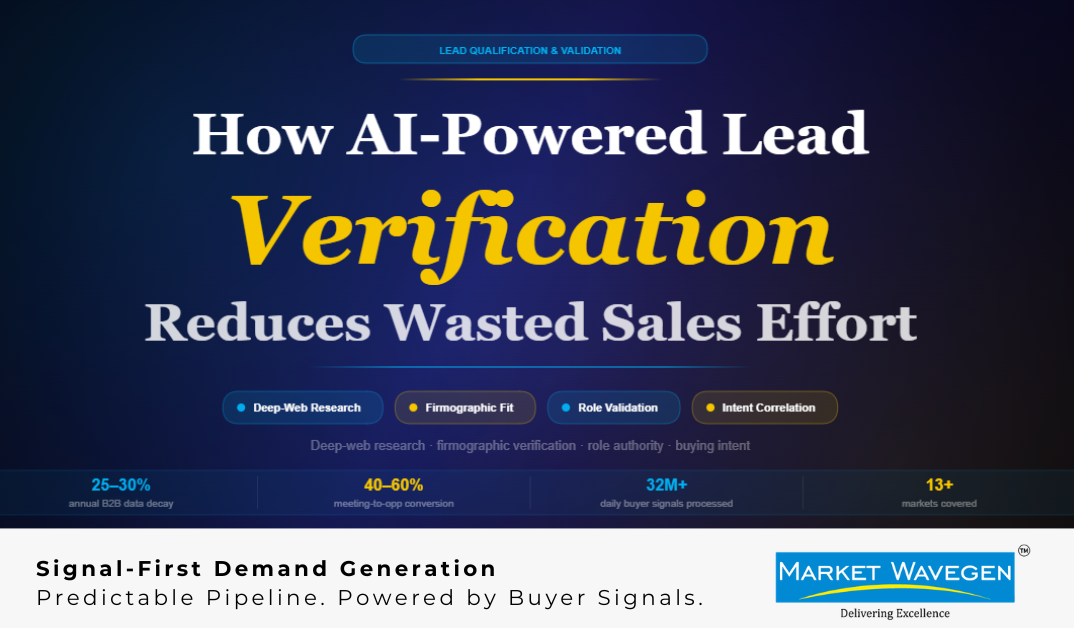
  • How AI-Powered Lead Verification Can Reduce Wasted Sales Effort

    How AI-Powered Lead Verification Can Reduce Wasted Sales Effort

    Most sales wasted effort does not happen in the sales call. It happens before it.

    It happens when a rep dials a number that has been disconnected for three months. When they spend forty minutes preparing for a discovery call with someone who has no budget authority. When they build a sequence for a company that stopped fitting the ICP six quarters ago but nobody updated the CRM. When they follow up twelve times on a lead that was never genuinely interested — just polite.

    These are not isolated failures. They are the structural output of a lead generation process that prioritises volume over verification. And they are expensive. Research from Salesforce consistently shows that sales reps spend less than a third of their time actually selling — the remainder goes to administrative tasks, data cleanup, and chasing leads that should never have been handed over in the first place.

    AI-powered lead verification changes this equation. Not by generating more leads, but by ensuring that the leads entering the pipeline have been confirmed against the dimensions that actually determine whether a sales conversation has a chance.

    Why Traditional Lead Verification Falls Short

    Legacy lead verification is largely a contact hygiene exercise. It asks: is this email address valid? Does this phone number connect? Is the company name spelled correctly?

    These checks matter. But they answer the wrong question. An email that delivers and a phone that rings tell you nothing about whether the person on the other end has the authority to buy, whether their company fits your ideal customer profile, or whether there is an active reason for them to be evaluating your category right now.

    Traditional verification also degrades fast. B2B contact data has an annual decay rate of 25–30% according to Dun & Bradstreet. People change roles, companies restructure, buying teams shift. A database that was clean in January is carrying significant inaccuracy by Q3 — and most organisations are not refreshing data at anything close to that frequency.

    The result is a hidden tax on sales productivity. Reps accept handoffs from marketing with no reliable way to know whether the underlying data is current, whether the contact is the right person, or whether the account is genuinely in-market. They find out through wasted conversations and missed quota.

    What AI-Powered Lead Verification Actually Does

    AI-powered lead verification is not a smarter email validator. It is a multi-layer intelligence process that runs against each lead before it reaches sales — confirming not just contact accuracy but role legitimacy, firmographic alignment, and market behaviour.

    The process works across four distinct verification layers.

    Layer 1 — Deep-Web Contact Research

    The first layer goes beyond the CRM record. AI systems trained on live web data can cross-reference a contact against their current LinkedIn profile, company website, published content, event speaker records, press mentions, and regulatory filings to confirm that the person exists as described, is still at the stated company, and holds a role consistent with what was captured.

    This deep-web research surfaces discrepancies that standard contact validation misses entirely:

    • A VP of Marketing who left the company four months ago may still be in your database — and still have a valid company email if the domain is not managed tightly
    • A job title that read “Head of Procurement” may now read “Director of Operations” at a different company
    • An email address may still deliver while the person has moved to a competitor

    AI verification catches these cases at scale and flags them before they reach the sales queue. The output is not just a valid contact — it is a confirmed, current contact at the right organisation.

    Market Wavegen’s verification process combines AI-powered deep-web research with human tele-validation to confirm every contact against their stated role and company before any outreach begins. The combination matters: AI provides scale and speed; human validation catches edge cases that automated systems misread.

    Layer 2 — Firmographic Verification

    The second layer confirms that the company itself still fits the criteria that made it a target in the first place.

    Firmographic data — company size, industry vertical, revenue band, headcount, technology stack, geographic footprint — changes continuously. A mid-market SaaS company that was 200 employees when it entered your database may have grown to 800 and moved upmarket, or may have been acquired and absorbed into a larger entity, or may have reduced headcount and moved outside your serviceable range.

    AI systems can verify current firmographic status against live sources including company websites, LinkedIn company pages, Crunchbase, Companies House filings, funding announcements, and industry databases. The verification answers a different set of questions than contact hygiene:

    • Is the company still operating independently?
    • Has its headcount or revenue changed materially since the lead was first captured?
    • Has it been acquired, merged, or restructured?
    • Is it still in the industry vertical your solution is built for?
    • Does its current technology stack still indicate a need for your category?

    Firmographic drift is one of the most underrecognised sources of wasted sales effort. A company that fitted your ICP perfectly eighteen months ago may have undergone changes that make it a poor target today — but without automated verification, that lead stays in your nurture queue, consuming resources and eventually generating a wasted sales engagement.

    Intelligent Database ABM™, Market Wavegen’s firmographic matching engine, runs continuous ICP alignment checks against live company data across 13+ markets — ensuring that accounts in the pipeline reflect current reality, not snapshot data from the day they were first captured.

    Layer 3 — Role and Authority Validation

    The third layer addresses the question that traditional verification ignores entirely: does this person have the authority to move a purchase decision forward?

    Role validation is distinct from title matching. A title match confirms that someone has the word “Director” or “VP” in their job description. Role validation confirms that they have actual decision-making authority or procurement influence in the specific category your solution addresses.

    This matters because titles are inconsistent across organisations:

    • A “Director of Sales Operations” at a 50-person company may own technology purchasing decisions outright
    • The same title at a 5,000-person enterprise may have no procurement authority at all — that sits with a centralised procurement function they never interact with
    • A title match would treat both leads identically. Role validation does not.

    AI-powered role validation cross-references reporting structure indicators, published content and conference participation in the relevant domain, LinkedIn activity and engagement with vendor content in the category, and historical patterns from comparable contacts at similar companies.

    The output is a calibrated confidence assessment for decision-making authority — not a binary yes/no, but a layered signal that allows sales and marketing to prioritise contacts most likely to advance a purchase.

    Market Wavegen’s tele-qualification layer adds a direct human check on top of the AI assessment — confirming authority through a brief qualification conversation before the lead is handed to sales. This removes the uncertainty that even well-calibrated AI scoring carries at the individual contact level.

    Layer 4 — Buying Signal and Intent Correlation

    The fourth layer moves beyond the static lead record to assess real-time market behaviour.

    A contact who passes identity, firmographic, and role validation is a qualified target. But they are not necessarily a sales-ready lead unless there is evidence of active buying behaviour in your category. Verification without intent correlation can produce a pipeline full of well-qualified contacts who are not in-market — which still generates wasted sales effort, just at a later stage in the funnel.

    AI systems correlate a verified contact against live intent signals:

    • Third-party content consumption on review sites, industry forums, and research platforms
    • Search behaviour indicating active evaluation of vendor options
    • Engagement with competitor content or competitor review threads
    • Trigger events at the account level — new executive hires, funding announcements, technology procurement signals, contract renewal windows approaching
    • Social signals indicating dissatisfaction with an incumbent vendor

    Mantech Mark™, Market Wavegen’s signal intelligence engine, processes over 32 million buyer signals daily across web, social, and intent data platforms. When a verified lead is correlated against active intent signals, the result is not just a clean contact — it is a confirmed in-market opportunity.

    The difference in conversion rates is measurable. Market Wavegen’s programmes deliver meeting-to-opportunity conversion rates of 40–60%, compared to 15–25% in volume-based demand generation — because verification and intent correlation together ensure that sales conversations begin with contacts who are ready to have them.

    The Compounding Effect on Sales Productivity

    The case for AI-powered lead verification is ultimately a productivity argument.

    Every wasted sales call carries a direct cost: the rep’s time, the sequence investment, the opportunity cost of not calling a better lead. But the indirect costs are often larger. Reps who consistently receive poor-quality leads lose confidence in the pipeline. They start their own informal verification processes — Googling contacts, checking LinkedIn before calling, asking SDRs to re-qualify before they engage. These are rational responses to a broken handoff process, but they consume exactly the time verification should have freed up.

    When verification is robust and systematic, the dynamic reverses. Sales receives contacts they can trust. Preparation time drops. Confidence in the pipeline increases. Call quality improves because reps are not walking into conversations with unresolved questions about whether the person is the right contact at the right company. Discovery moves faster because the foundational qualification has already been done.

    The downstream effects extend to pipeline forecasting. A pipeline built on verified leads has less variance in conversion rates — which means forecast accuracy improves, resource planning becomes more reliable, and revenue leaders can make better decisions about where to invest in additional capacity.

    What to Look for in an AI Lead Verification Partner

    Not all AI-powered verification operates at the same depth. When evaluating a solution or partner, the questions that matter are:

    Does it verify role authority, or just title? Title matching is not role validation. A genuine verification process should be able to distinguish a procurement-influencing VP from a VP in name only.

    How current is the underlying data? Verification is only as good as the data it runs against. Partners should be able to demonstrate the refresh frequency of their reference datasets and their methodology for detecting stale records.

    Does it include intent correlation, or just contact hygiene? A verified contact who is not in-market generates wasted effort at a later stage. True verification should include some assessment of buying behaviour, not just static record accuracy.

    Is there a human validation layer? AI verification is powerful at scale, but calibrated confidence scores are not certainties. A human tele-qualification layer that confirms intent, authority, and timing through a direct conversation closes the gap between AI assessment and sales-ready certainty.

    Is it compliant across your target markets? B2B outreach in the EU, UK, and increasingly in APAC markets operates under strict data handling requirements. A verification partner operating across these markets should carry relevant certifications — ISO 27001, ISO 27018, and EU GDPR compliance at minimum.

    Market Wavegen’s programmes are ISO 9001, ISO 14001, ISO 27001, ISO 27018, ISO 37001, and EU GDPR certified — operating across 13+ markets with regional execution teams who conduct qualification in the buyer’s language and time zone.

    Verification Is Not an Additional Step. It Is the Foundation.

    The framing that treats lead verification as a pre-sales hygiene task misses what it actually is: the foundation on which reliable pipeline is built.

    Without it, sales teams are working on unconfirmed assumptions. The contact might be the right person. The company might still fit. There might be a reason to buy. Every call carries that uncertainty — and uncertainty at scale produces the wasted effort that depresses sales productivity, distorts pipeline data, and erodes the relationship between sales and marketing.

    AI-powered verification removes the uncertainty before it reaches the rep. Not by slowing the pipeline down, but by ensuring that what flows through it has been confirmed against the dimensions that actually predict conversion: identity verified, role validated, firmographic fit confirmed, buying intent detected.

    Sales effort applied to verified leads is not just more efficient. It converts at a fundamentally different rate — because it starts from a fundamentally different foundation.

    How Market Wavegen Verifies Before Sales Engages

    Market Wavegen’s six-layer lead validation process applies AI-powered deep-web research, firmographic verification, role and authority validation, and Mantech Mark™ intent signal correlation to every lead before it reaches your sales team.

    Every programme includes human tele-qualification as the final confirmation layer — ensuring that timing, budget alignment, and decision-maker readiness are confirmed through a real conversation, not inferred from a score.

    The result is a pipeline your sales team can trust — and a conversion rate that reflects it.
  • What Makes a Lead Sales-Ready in Modern B2B Sales?

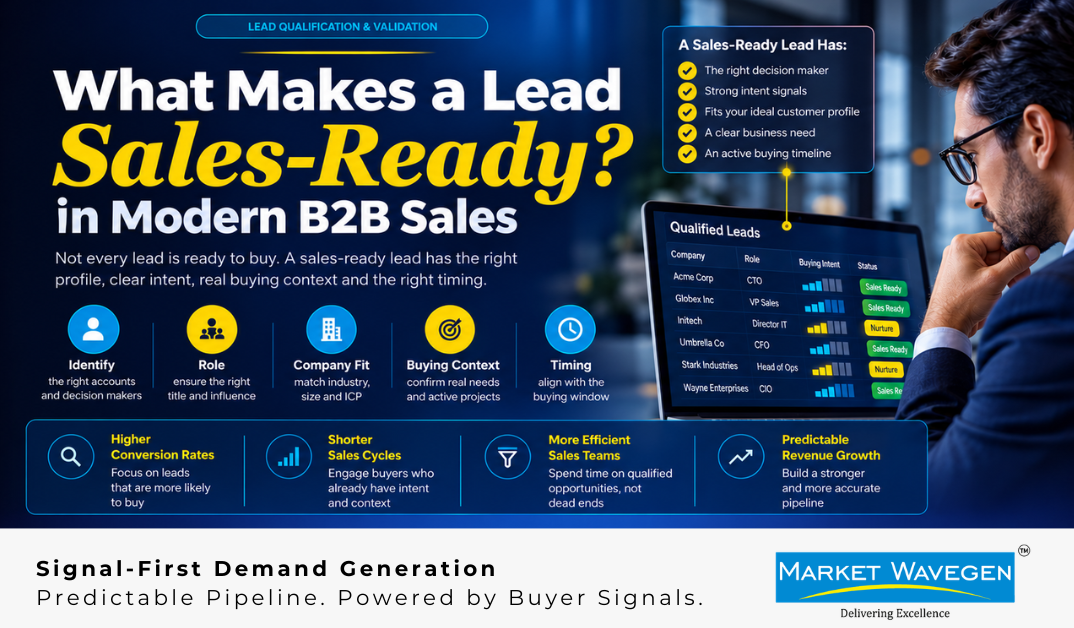
    What Makes a Lead Sales-Ready in Modern B2B Sales?

    Most B2B revenue teams are working with a broken definition of “sales-ready.”

    They define it as a lead scoring threshold. A number that climbs when someone opens emails, visits pricing pages, or downloads a guide. When the score crosses a line someone drew in a spreadsheet, the lead gets routed to sales — and the friction begins.

    Sales pushes back. The meeting does not convert. The lead goes cold. Marketing adds more nurture tracks. The cycle repeats.

    The problem is not the lead. The problem is the definition. A score built on engagement activity does not answer the question sales actually needs answered before they pick up the phone: Is this the right person, at the right company, with a real reason to buy, right now?

    That question has five components. Until all five are answered, a lead is not sales-ready — it is just warmed up.

    The Five Dimensions of a Sales-Ready Lead

    Modern B2B qualification is not a checklist to rush through. It is a structured evidence-gathering process that confirms five specific things before any sales conversation begins. Miss one dimension and you are handing sales a gamble dressed as an opportunity.

    Dimension 1 — Identity: Is This a Real, Reachable Person?

    Before anything else, the lead must be a verified human being with accurate, deliverable contact information.

    This sounds obvious. It is routinely ignored.

    In practice, B2B lead databases carry a 25–30% data decay rate annually (Dun & Bradstreet). Job titles change, people leave companies, emails bounce, phone numbers disconnect. A lead that looked clean six months ago may be completely unreachable today. If your team cannot reach the person, every other qualification dimension is irrelevant.

    Identity verification covers:

    • Full name confirmed and correctly spelled
    • Email address validated (format check, domain check, deliverability check)
    • Direct dial or mobile number verified against current employment
    • LinkedIn profile active and consistent with stated role and company
    • No obvious indicators of a false or fictitious identity

    Market Wavegen’s six-layer validation process begins with identity as the foundational layer. No lead advances without a confirmed, reachable person behind it — because sales-ready starts with being reachable at all.

    Dimension 2 — Role: Does This Person Have Influence or Authority?

    A real, reachable person at the wrong level of seniority is still the wrong lead.

    B2B purchases above a certain value threshold almost always involve multiple stakeholders — Gartner research puts the average enterprise buying group at six to ten decision-makers. But not all stakeholders are equal. Your ideal contact needs to be either a decision-maker who can approve spend, an influencer who shapes the shortlist, or a champion who will advocate internally for your solution.

    Role qualification answers:

    • What is the person’s actual title, and does it reflect genuine authority in their organisation?
    • Do they have budget ownership, or are they an end user without procurement influence?
    • Are they involved in vendor evaluation for this category of solution?
    • Is there a more senior economic buyer who also needs to be engaged?
    • What is their likely pain — does it align with what your solution solves?

    A marketing coordinator who downloaded your whitepaper is not the same as a VP of Revenue Operations who requested a demo. Both may score identically in a traditional lead scoring model. Only role qualification separates them.

    Dimension 3 — Company Fit: Is the Organisation a Genuine ICP Match?

    Even the right person at the wrong company creates a dead end. Company fit qualification confirms that the organisation behind the lead matches the Ideal Customer Profile your revenue team has defined — not approximately, but specifically.

    ICP matching at the company level covers:

    • Industry vertical — does the company operate in the sectors your solution is built for?
    • Company size — headcount and revenue within range for your deal size and product tier
    • Geography — operating in a market you can actually service and close
    • Tech stack — using or evaluating tools that integrate with or are replaced by yours
    • Growth stage — a company in active expansion is structurally more likely to invest than one in cost-cutting mode
    • Existing vendor relationships — are they locked into a competitor, or approaching a contract review window?

    An 80% ICP match is not a strong ICP match. The closer the company fits, the shorter the sales cycle, the higher the win rate, and the lower the cost of acquisition. Qualification at this level is not gatekeeping — it is pipeline quality control.

    Dimension 4 — Buying Context: Is There a Real Problem Being Actively Addressed?

    Company fit tells you the organisation could buy. Buying context tells you whether they are actually in-market to buy.

    This is where modern signal intelligence separates high-performing revenue teams from everyone else. A company that fits your ICP perfectly may have zero active buying intent today — and be intensely in-market six months from now. Contacting them at the wrong moment burns the relationship. Contacting them at the right moment starts a conversation.

    Buying context is confirmed through:

    • Research signals — is the account actively researching your category across third-party review sites, communities, and industry forums?
    • Competitor dissatisfaction — are there signals of frustration, contract complaints, or open evaluation of alternatives to an incumbent vendor?
    • Trigger events — has the company recently hired a new executive, raised funding, announced expansion, or entered a new market?
    • RFP or evaluation activity — are there indicators of a formal vendor selection process beginning?
    • Stated problem alignment — in direct qualification conversations, does the contact articulate a problem your solution solves, in their own words?

    At Market Wavegen, Mantech Mark™ processes over 32 million daily buyer signals to surface accounts showing active in-market behaviour before competitors can see it. Buying context is not inferred — it is detected from real market activity and confirmed through human-led tele-qualification.

    A lead without confirmed buying context is not a lead. It is a profile.

    Dimension 5 — Timing: Is the Window Open Right Now?

    The final dimension collapses more opportunities than any other — and it is the one most qualification frameworks ignore entirely.

    Timing is not about patience. It is about whether the conditions inside the buying organisation are aligned for a purchase decision to move forward in the near term. A perfectly qualified lead — right person, right company, active buying context — can still be the wrong lead if the budget cycle is frozen, the decision-maker is changing, or a competing internal priority has pushed the evaluation back.

    Timing qualification covers:

    • Budget cycle alignment — are they in a period where budget can be approved, or locked until the next cycle?
    • Decision timeline — do they have a stated or implied timeline for making a decision?
    • Internal priority alignment — is this problem in the top three priorities of the executive sponsor?
    • Stakeholder readiness — are the key decision-makers available and engaged, or is the buying process stalled at a political level?
    • Contract renewal windows — if they are using a competing solution, when does the contract expire?

    Timing is the dimension that transforms a qualified lead into a sales conversation worth having this quarter. Without it, sales engages at the wrong moment — and the opportunity is often lost, not because the lead was wrong, but because the contact arrived before the organisation was ready.

    What Happens When All Five Are Confirmed

    A lead that has been validated across all five dimensions — identity, role, company fit, buying context, and timing — arrives in sales with something that volume-based demand generation almost never provides: certainty.

    The sales team knows exactly who they are calling. They know the person has authority. They know the company is a genuine fit. They know there is an active reason to buy. And they know the timing is right.

    That certainty changes the entire sales conversation. Discovery is faster. Trust is established earlier. Objections are fewer. Cycles are shorter. Win rates climb.

    This is not a theoretical outcome. Market Wavegen’s tele-qualification programmes consistently deliver meeting-to-opportunity conversion rates of 40–60%, compared to 15–25% in volume-based demand generation programmes — because every meeting starts from five confirmed dimensions, not a lead score.

    The Framework in Practice

    Building a five-dimension qualification framework into your demand generation engine requires three structural changes:

    Replace lead scoring with evidence requirements. A score is an opinion. A confirmed data point is evidence. Define what confirmed evidence looks like for each dimension — and do not advance a lead that has not met the evidence standard, regardless of score.

    Add human validation before sales handoff. AI and intent data can surface buying context signals at scale. But the final confirmation of timing, stakeholder readiness, and genuine problem alignment requires a human conversation. Tele-qualification is not a relic. It is the layer that closes the gap between signal and certainty.

    Build feedback loops between sales and marketing. Every lead that enters sales and fails to convert is diagnostic data. Was the identity wrong? Was the role too junior? Was the timing off? Systematic post-handoff feedback allows the qualification framework to improve with every cycle — instead of repeating the same misqualification at scale.

    Sales-Ready Is a Standard, Not a Score

    In modern B2B sales, the definition of sales-ready has to be rebuilt from the ground up.

    Not as a number that climbs when someone clicks. As a confirmed set of conditions — identity verified, role relevant, company aligned, context active, timing open — that together tell sales exactly one thing: this is worth your time.

    Every lead that reaches your sales team without all five dimensions confirmed is a tax on sales productivity. Every lead that arrives with all five confirmed is a genuine opportunity.

    The difference between the two is not volume. It is validation.

    How Market Wavegen Qualifies Leads Across All Five Dimensions

    Market Wavegen’s six-layer lead validation process is built on exactly this framework — combining Mantech Mark™ signal intelligence, Flip Signals™ emotional intent data, Intelligent Database ABM™ ICP matching, and human-led tele-qualification to confirm identity, role, company fit, buying context, and timing before any lead is handed to sales.

    Every programme runs on ISO-certified data, across 13+ markets, with regional execution teams who conduct qualification conversations in the buyer’s language and time zone.

    The result is not a bigger pipeline. It is a pipeline where every entry is already sales-ready.

  • The gap that costs B2B revenue teams more than any campaign ever could.

    The gap that costs B2B revenue teams more than any campaign ever could.

    The problem hiding in plain sight

    Most B2B organizations have a demand generation problem that doesn’t look like one.

    The campaigns are running. The content is performing. The leads are coming in. Marketing is hitting its MQL targets. On paper, the top of the funnel is healthy.

    And yet — quarter after quarter — pipeline underperforms. Sales cycles stall. Win rates disappoint. Forecasts miss. The CFO asks the same question, and no one has a satisfying answer.

    The problem is not the leads. It is what happens — or more accurately, what does not happen — between a lead being captured and a sales conversation beginning.

    That gap has a name: the missing validation layer. And for most B2B revenue teams, it is the single most expensive structural failure in their entire GTM motion.

    What lead validation actually means

    Lead validation is not a single checkbox. It is not email verification. It is not running a name through a contact database to confirm the record exists.

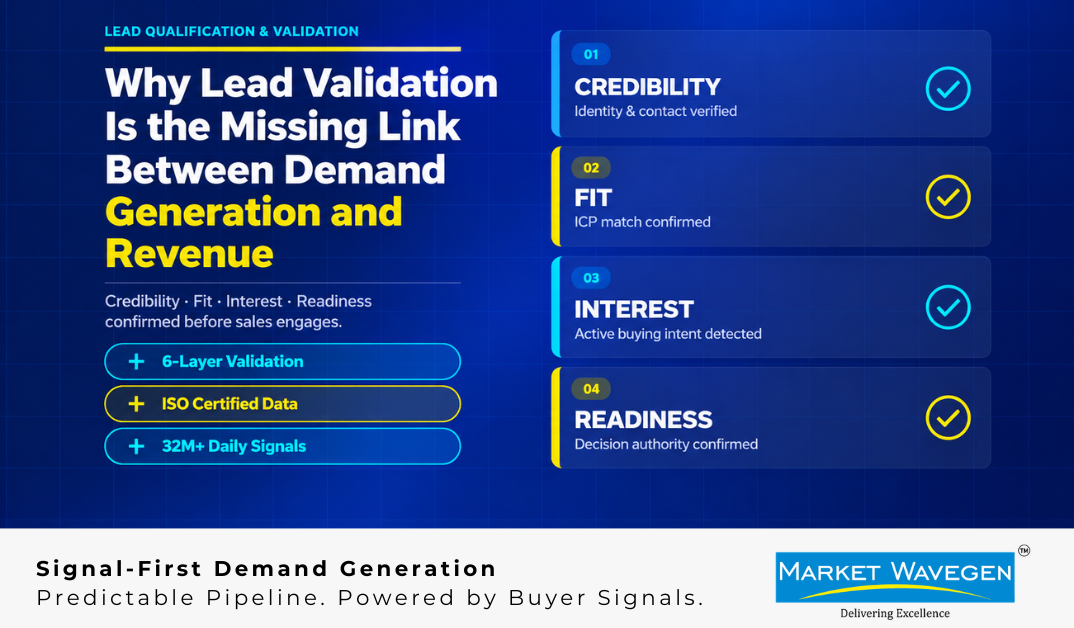
    Real lead validation answers four questions that determine whether a lead deserves sales attention:

    1. Credibility — Is this a real person at a real company that could genuinely become a customer? Has the business been confirmed as legitimate, active, and operating in the right industry and geography?

    2. Fit — Does this account match the ICP? Does the company size, revenue band, technology environment, and growth stage align with what the solution is actually built for?

    3. Interest — Did this person engage with the content deliberately, or did a form get filled by someone who will not remember it tomorrow? Is there observable evidence of genuine category consideration?

    4. Readiness — Is this account in an active evaluation window, or are they twelve months away from any buying decision? Is there urgency, or only vague curiosity?

    When all four are confirmed — and only when all four are confirmed — a lead is ready for sales engagement. Anything short of that, and a sales conversation is not an opportunity. It is a friction event that damages trust, wastes capacity, and quietly closes a buying window that was genuinely open.

    Why demand generation alone cannot close this gap

    Demand generation is built to create the signal — to put the right content in front of the right audience and attract the attention of accounts that could eventually become customers.

    It is not built to verify what happens next.

    The moment a prospect fills a form, downloads a report, or responds to an email, demand generation has done its job. What follows — confirming the identity, validating the fit, verifying the interest, and assessing the readiness — is an entirely different function. And in most B2B organizations, it either doesn’t happen at all, or it happens too slowly, too inconsistently, and too far downstream to matter.

    The industry data on this is unambiguous:

    • Marketing Sherpa’s research shows only 56% of B2B organizations verify a lead as valid before handing it to sales — meaning nearly half of all pipeline entries are built on unconfirmed assumptions from day one.
    • B2B contact data decays at rates between 22.5% and 70.3% annually, with approximately three-quarters of prospect databases becoming partially or wholly outdated within a single year (Landbase, 2026 Data Decay Rate Statistics).
    • Sales representatives lose roughly 27% of their working time — estimated at 546 hours per year — chasing leads built on bad, incomplete, or outdated data (Landbase, 2026, citing ZoomInfo research).
    • 37% of CRM users report losing revenue directly because of poor data quality, with companies losing an average of 16 sales opportunities every quarter to unreliable records (Validity’s 2025 State of CRM Data Management Report, via Salesmotion 2026).
    • Salesforce’s own research found that 91% of CRM data is incomplete, stale, or duplicated (Salesmotion, 2026).

    These are not fringe findings. They represent the standard operating reality for the majority of B2B revenue organizations. And they point to the same structural conclusion: demand generation and sales engagement are two activities that have a critical third step between them — validation — that most teams have never built.

    The cost of skipping validation

    When a lead moves from capture directly to sales without passing through a validation layer, the consequences stack up quickly across the entire revenue organization.

    Sales capacity is consumed by qualification that should already be done. Every rep who picks up the phone to call a lead that turns out to be the wrong person, the wrong company, or the wrong timing has spent irreplaceable selling time on an activity that a validation system would have handled in minutes.

    Trust between sales and marketing erodes permanently. Once a sales team learns from experience that a large percentage of marketing-generated leads are not worth calling, they stop calling them. The pipeline they were supposed to work becomes invisible. Marketing doubles down on volume to compensate. The cycle worsens.

    Buyer urgency windows close before contact is made. A prospect who engaged with content today is not the same buyer three days from now. Priorities shift. Attention moves. Other vendors make contact. Delay — caused by the absence of a real-time validation layer — is often the difference between an opportunity that opens and one that closes before sales ever knows it existed.

    Forecast accuracy deteriorates. When unvalidated leads enter the CRM, they inflate pipeline. Sales managers and revenue leaders build forecasts on a foundation that looks solid but isn’t. The gap between projected and actual revenue becomes structural, not occasional.

    The four dimensions of a real validation layer

    Closing the gap between demand generation and revenue requires building validation as a permanent, systematic layer inside the demand engine — not as an afterthought, not as a manual SDR function, and not as a retrospective audit of why deals didn’t close.

    A complete validation layer operates across four dimensions simultaneously:

    Credibility Validation
    Every lead that enters the system is cross-referenced against deep-web data sources to confirm that the company is real, active, and operating in the relevant industry and geography. This step eliminates the phantom leads, the inactive businesses, and the misidentified records that consume disproportionate sales attention for zero commercial return.

    Firmographic Fit Validation
    Confirmed leads are evaluated against ICP criteria — company size, revenue band, employee count, technology stack, growth indicators, and vertical alignment. A lead that passes credibility checks but fails ICP fit is not an opportunity. It is a distraction. Removing it at this stage protects sales capacity for accounts that could actually close.

    Engagement and Interest Validation
    The lead’s stated reason for engaging — and their actual engagement behavior — is confirmed through real interaction. An automated email referencing the specific asset they engaged with creates a second, independently verifiable data point and reinforces the interaction in the prospect’s memory. Engagement confirmation transforms a form-fill from an assumption into a documented signal.

    Readiness and Intent Validation
    This is the dimension most demand generation systems never reach. A voice-level interaction — whether human or AI-led — confirms that the prospect’s interest is current, that urgency or budget motivation exists, and that a sales conversation would be welcomed rather than resented. Only accounts that pass at this level are handed to sales as active opportunities.

    What ConvrsAI closes

    This four-dimensional validation architecture is exactly what ConvrsAI is built to execute — and it runs at the moment of lead capture, not days later when urgency has already faded.

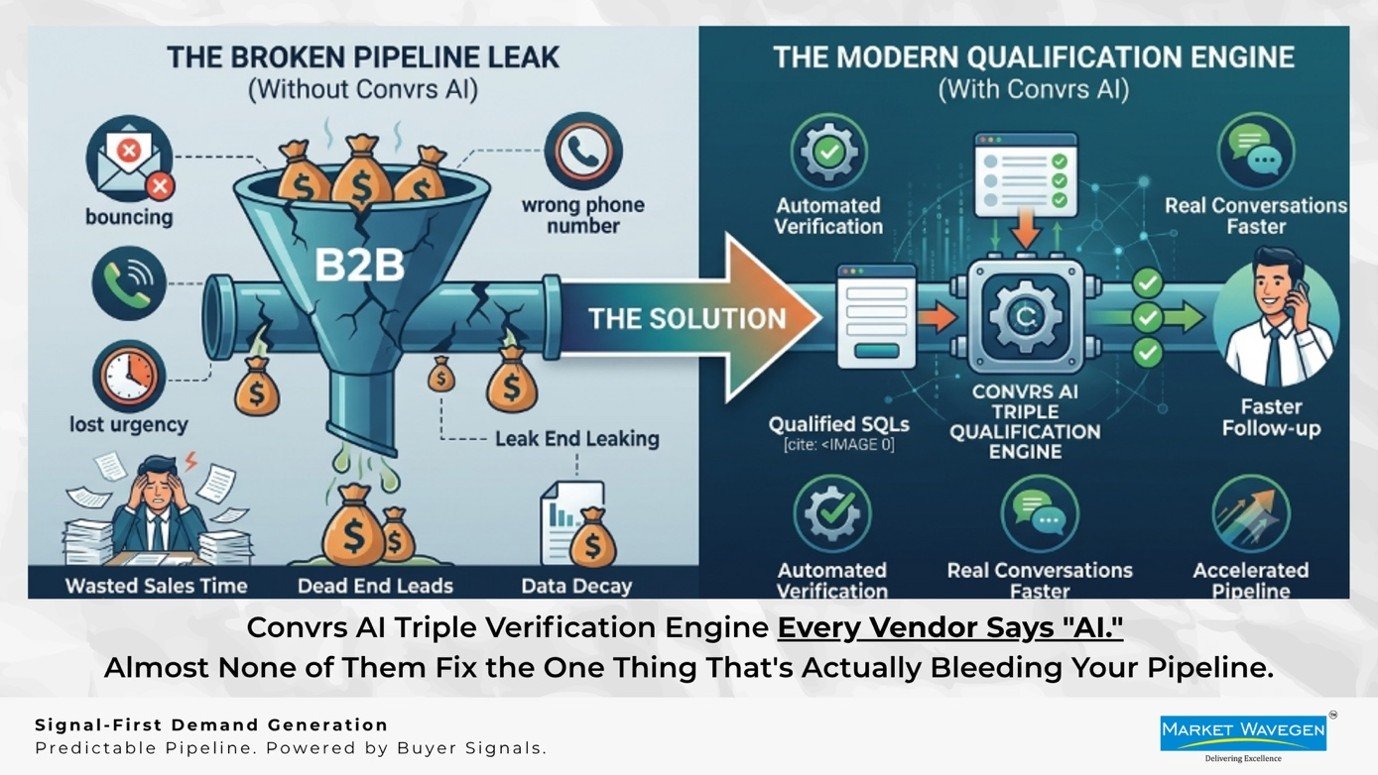
    The moment a lead enters the system, ConvrsAI initiates a real-time, three-stage verification sequence:

    A deep-web research pass validates the company’s legitimacy, industry classification, and the accuracy of the contact’s stated role and title against current-state data — not a database snapshot that may be months old.

    An automated confirmation email is triggered immediately, referencing the specific content the prospect engaged with. This closes the “I don’t remember filling out that form” gap before it can damage the sales conversation, and creates a working email confirmation as a second verification signal.

    A conversational AI voice call confirms that the phone number is live, verifies the prospect’s genuine engagement with the content, and captures their current interest level in their own words — in real time. No more reps discovering a dead number on the third attempt. No more opening a sales conversation with a buyer who has no context for why they’re being called.

    By the time a lead reaches a sales representative through ConvrsAI, it has cleared three independent verification layers. The rep already knows the number works, the person remembers the interaction, and the interest is confirmed — not assumed.

    What changes when validation is real

    The impact of a genuine validation layer — one that runs at signal speed, not at the pace of a weekly SDR review — is not incremental. It is structural.

    • Meeting acceptance rates increase because outreach arrives when buyers are genuinely in a consideration window, not arbitrarily timed to a campaign schedule
    • First-conversation quality improves because sales enters with confirmed context rather than discovery questions that should have been answered upstream
    • Sales cycle length decreases because qualification is complete before engagement begins, compressing the early stages of every deal
    • CRM data accuracy improves because only validated, confirmed records enter the system in the first place
    • Marketing and sales alignment strengthens because both teams are working from the same verified, evidence-backed view of what a real opportunity looks like

    The math changes because the starting point changes. Instead of 1,000 leads producing a fraction of real opportunities, a smaller number of validated leads produces a significantly higher proportion of actual pipeline — with lower cost per opportunity and higher win rates.

    The validation layer is not optional in 2026

    AI has amplified the demand generation problem, not solved it. When AI SDRs and AI-generated outreach sequences are applied to unvalidated lead pools, they do not improve pipeline. They execute bad decisions faster, at greater scale, with greater cost — emailing contacts who left the company six months ago, referencing initiatives that have already been cancelled, calling numbers that were never correct.

    The answer is not to slow down demand generation. It is to build the layer that makes demand generation’s output trustworthy before it reaches sales.

    Lead validation — credibility, fit, interest, and readiness, confirmed in real time at the moment of signal — is not a nice-to-have refinement in a B2B demand engine. It is the missing link that determines whether the investment upstream in campaigns, signals, content, and outreach produces revenue or produces noise.

    The difference between demand generation that fills a CRM and demand generation that fills a pipeline is a validation layer. Build it, and the math of B2B revenue changes permanently.


  • Convrs AI Triple Verification Engine: Every Vendor Says “AI.” Almost None of Them Fix the One Thing That’s Actually Bleeding Your Pipeline.

    Convrs AI Triple Verification Engine: Every Vendor Says “AI.” Almost None of Them Fix the One Thing That’s Actually Bleeding Your Pipeline.

    How Market Wavegen’s Convrs AI Triple Verification Engine closes the gap between a form-fill and a real conversation before your sales team ever picks up the phone.

    The problem every B2B revenue leader already knows by heart

    A prospect fills out a form. Marketing marks it an MQL. Sales picks up the phone to follow up and hits a dead end. The number’s wrong. The email bounces. The person barely remembers downloading the asset, if they even filled out the form themselves. Days later, when someone finally does get a “real” conversation going, the moment has already passed the buyer has moved on, lost urgency, or is now talking to a competitor who called first.

    This isn’t a one-off annoyance. It’s a structural leak in nearly every demand generation motion running today, and 2026 has made it worse, not better because every vendor claiming “AI-powered” lead gen is pouring more volume into the same broken verification layer.

    The data backs this up, from every corner of the industry:

    • B2B contact data decays at rates between 22.5% and 70.3% annually, with roughly three-quarters of prospect databases becoming outdated within a single year (Landbase, 2026 Data Decay Rate Statistics).
    • Poor data quality is estimated to cost U.S. businesses $3.1 trillion a year, and individual organizations report losing $12.9 to $15 million annually through wasted spend and missed opportunities (Landbase, 2026).
    • 70.8% of business contacts change in some way within 12 months — nearly 43% see a phone number change and over 37% see an email change in that same window (Landbase, 2026).
    • Sales reps lose roughly 27% of their working time — some 546 hours a year — chasing leads built on bad data (Landbase, 2026, citing ZoomInfo research).
    • According to Validity’s 2025 State of CRM Data Management report, 37% of CRM users report losing revenue directly because of poor data quality, with companies losing an average of 16 sales opportunities every quarter to unreliable records (Salesmotion, 2026).
    • Salesforce’s own research found that 91% of CRM data is incomplete, stale, or duplicated (via Salesmotion, 2026).
    • Marketing Sherpa’s research shows just 56% of B2B organizations even verify a lead as valid before handing it to sales — meaning nearly half the funnel is built on an unconfirmed guess from day one (via Carla Johnson, B2B Sales and Marketing Alignment Statistics).
    • Forrester and Marketing Evolution found that 21% of marketing budgets are wasted directly because of bad data (2019 study, via LinkedIn/7 Strategies to Combat Bad Data Quality).

    Put plainly: the industry has spent the last two years bolting “AI” onto lead generation volume more signals, more scoring, more outreach cadences without fixing the one point of failure that determines whether any of it converts: is the lead even real, reachable, and still interested by the time sales calls?

    That’s the gap Convrs AI is built to close.

    Enter Convrs AI: the industry’s first Triple Qualification Engine

    Market Wavegen already runs demand generation on Mantech Mark™, its ISO-certified signal intelligence platform tracking 32 million+ daily buyer signals across a base of 147M+ professionals and 498M+ companies. Convrs AI is the next layer on top of that foundation purpose-built to eliminate the exact failure point sales and marketing teams have been living with for years.

    Instead of treating a form-fill as the finish line, Convrs AI treats it as the starting gun for a real-time, three-stage verification sequence:

    1. AI-Enabled Research & Deep Verification

    The moment a lead fills out a form, Convrs AI doesn’t just check the fields the person typed. It runs a full deep-web research pass against the prospect’s stated identity cross-referencing industry, company revenue band, and job title against live, current-state data, not a static database snapshot. If something doesn’t line up a title that’s changed, a company that’s been acquired, a role that no longer exists the system flags it before your reps ever dial.

    2. Instant Confirmation Email

    In parallel, Convrs AI triggers an automated confirmation email to the prospect, referencing the specific asset they engaged with. This does two things at once: it reinforces the interaction in the prospect’s memory (closing the “I don’t recall downloading that” gap), and it creates a second, independently verifiable data point a working email that the prospect can act on.

    3. Human-Grade AI Voice Verification

    This is the layer most demand gen stacks simply don’t have. Convrs AI places a call to the prospect through a conversational AI agent that confirms the phone number is live, verifies the prospect engaged with the content, and captures their real interest level in their own words, in real time. No more sales reps discovering a dead number three call attempts in. No more “I have no idea what asset you’re referring to.”

    By the time a lead lands on a rep’s desk, it has already cleared three independent layers of verification: data accuracy, engagement confirmation, and voice-confirmed intent something no traditional MQL workflow, and no single-layer “AI lead scoring” tool, currently does.

    Why this matters more in 2026 than it did even a year ago

    The stakes here are compounding, not static:

    • AI is now amplifying the data problem, not just the outreach problem. As one 2026 industry analysis put it, when 45% of CRM data isn’t AI-ready (Salesmotion, 2026, citing Validity’s 2025 report), AI SDRs and AI-generated outreach simply execute bad decisions faster and at greater scale — emailing contacts who left the company months ago, referencing initiatives that no longer exist. Speed without verification just means failing faster.
    • Companies losing an average of 16 opportunities per quarter to bad data isn’t a rounding error — at a modest $50K average deal size, that’s millions in evaporated pipeline every year, for a problem that is entirely preventable at the point of lead capture.
    • Buyer emotion and intent are perishable. Waiting even a few days to confirm interest means engaging a prospect after their urgency, budget window, or internal champion has already moved on.

    Convrs AI is built around a simple premise: verification has to happen at the moment of the signal, not days later when a rep finally gets a callback. That’s the shift from lead volume to lead certainty and it’s the differentiator most companies talking about “AI in marketing” in 2026 still haven’t built.

    The bottom line

    Every company is now saying “AI” in their positioning. Very few are pointing that AI at the actual point of failure the fragile, decaying, unverified moment between a form-fill and a sales conversation. Market Wavegen’s Convrs AI Triple Verification Engine: was built specifically to close that gap: verifying identity and firmographic accuracy through deep research, confirming engagement through an automated email touchpoint, and validating real interest through a live AI voice interaction all within moments of the original form-fill, and all before a single sales hour is spent.

    The result isn’t just cleaner data. It’s a fundamentally different starting point for every sales conversation: one where the rep already knows the number is real, the person remembers the interaction, and the interest is confirmed not assumed.

    Sources: Landbase 2026 Data Decay Rate Statistics; Salesmotion (2026) on B2B data decay and CRM data readiness, citing Validity’s 2025 State of CRM Data Management report and Salesforce research; Industry Select, “Measuring the High Cost of Bad Contact Data”; Marketing Sherpa research via Carla Johnson’s B2B Sales and Marketing Alignment statistics compilation; Forrester/Marketing Evolution 2019 study on marketing budget waste.

  • Why Your Pipeline Confidence Is Broken — and How Signal Intelligence Fixes It

    Why Your Pipeline Confidence Is Broken — and How Signal Intelligence Fixes It

    The Scene That Plays Out Every Quarter

    The CRM looks healthy. The pipeline number is strong. The sales team sounds confident. The CFO signs off on the forecast.

    Then the quarter closes — and the numbers miss.

    This is not a sales execution problem. It is not a messaging problem. It is not even a lead volume problem.

    It is a pipeline confidence problem — and it starts the moment your team begins treating activity as intent.


    Why Most B2B Pipelines Cannot Be Trusted

    Every B2B revenue leader has felt the weight of this question: Why does our pipeline consistently fail to convert at the rate we forecast?

    The answer is structural. The average enterprise pipeline contains between 40% and 60% of deals that will never close — not because the sales team lacks skill, but because the accounts entered the pipeline before they were genuinely ready to buy.

    They filled a form. They downloaded a report. They opened three emails. None of these actions signal buying readiness. All of them signal vague awareness at best.

    When your pipeline is built on activity signals — clicks, opens, page visits, form fills — it looks full. It feels real. But it collapses when sales engages, because the underlying intent was never there.

    The result is familiar:

    • Sales cycles lengthen as teams invest time in accounts that are not yet ready
    • Win rates decline because discovery conversations start with buyers who are still in research mode
    • Forecast accuracy erodes quarter after quarter as CFO trust in projections weakens
    • Marketing doubles down on volume to compensate for low conversion — making the problem worse, not better
    • The gap between pipeline and revenue becomes structural, not temporary

    This is the pipeline confidence crisis. And it is not solved by more leads. It is solved by better evidence.


    The Real Problem: Activity Is Not Intent

    Traditional lead scoring models were built to solve exactly this problem. They assigned numerical values to buyer actions and used accumulated scores to prioritise outbound effort. In a world where buyer journeys were linear and predictable, this approach made reasonable sense.

    In 2026, it no longer does.

    Today’s B2B buyers research anonymously. They compare vendors in communities your tracking pixels cannot reach. They build evaluation shortlists in Slack channels and peer review forums before your SDR ever sends the first email. They involve procurement, legal, and finance weeks before any vendor contact is made.

    By the time a contact scores highly in your marketing automation platform, they may already be three months into an evaluation cycle your team knows nothing about — and two of your competitors are already on their shortlist.

    This is the signal gap. And it is the structural cause of every pipeline confidence failure.

    The question your current system is asking is: “What did this person do on our website?”

    The question that actually predicts pipeline is: “What is this account actively doing in the market right now?”

    These are different questions. They produce different data. And they produce profoundly different pipeline quality.


    What Signal Intelligence Actually Measures

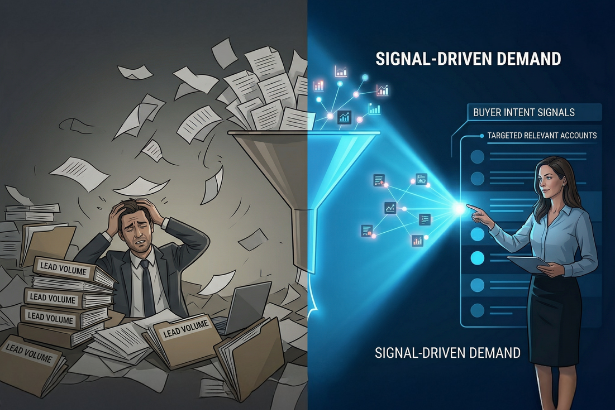
    Signal intelligence does not replace demand generation. It upgrades the evidence layer beneath it — replacing activity scores with behavioural intent that exists in the market, not just on your owned channels.

    At Market Wavegen, every program runs on Mantech Mark™, our ISO-certified signal intelligence platform that analyses more than 32 million daily buyer signals across industries, geographies, and buying journeys.

    Mantech Mark™ monitors five categories of real-market intent:

    1. Research Behaviour The earliest indicator of active consideration. When an account begins investigating a category — not a specific vendor, but the problem category — it reveals the opening of a buying window before most competitors can see it.

    2. Product Comparisons Side-by-side vendor evaluations signal shortlist-stage activity. An account comparing your category at this depth is not browsing. They are building a decision architecture.

    3. Competitor Dissatisfaction Negative sentiment, contract complaints, churn indicators, and public switching intent. When a buyer is frustrated with their current vendor, there is a narrow window of high receptivity to alternatives. Flip Signals™ — our emotional buyer intent layer — captures not just what buyers do, but why they are doing it, detecting frustration, urgency, and optimism as distinct emotional signals.

    4. Renewal and Contract Cycles Predictable pipeline entry windows tied to existing vendor contract dates. Accounts approaching renewal are structurally open to re-evaluation. Knowing when this window opens — before the account formally enters a buying process — is the single most reliable source of early-stage competitive advantage.

    5. Hiring and Expansion Signals New role postings, leadership transitions, funding announcements, and geographic expansion all indicate budget availability and organisational readiness to invest. These are buying readiness signals hiding in plain sight.

    Signal intelligence does not tell you what buyers did on your website. It tells you what they are doing in the market — before they ever visit your website.

  • Your MQL Is Not a Sales Lead: The Costly Mistake Killing B2B Pipeline

    Your MQL Is Not a Sales Lead: The Costly Mistake Killing B2B Pipeline

    There’s a quiet but expensive mistake happening inside most B2B organizations.

    It looks productive. It feels efficient. It shows up as speed, activity, and responsiveness.

    But in reality, it’s destroying pipeline.

    The moment a Marketing Qualified Lead comes in, sales jumps in. Calls are made within hours. Sequences are triggered. Calendars are pushed.

    And just like that, the opportunity is gone.

    Not visibly. Not dramatically. But permanently.

    Because here’s the uncomfortable truth: your MQL is not a sales lead.

    The Core Misunderstanding That Breaks Pipeline

    An MQL is not a buying signal.

    It’s a learning signal.

    When someone downloads a guide, attends a webinar, or clicks through a few emails, they are not raising their hand to speak to sales. They are trying to understand a problem.

    They are early. Curious. Uncertain.

    And most importantly, they are still forming their perspective.

    Yet most B2B systems treat this moment as a trigger for immediate sales outreach. That assumption creates friction at the exact moment when trust should be built.

    The result is predictable.

    • The buyer feels interrupted
    • The conversation lacks context
    • The relationship never forms

    And what gets logged in the CRM is deceptively simple: “Not interested.”

    But that’s not what actually happened.

    What Buyers Are Really Doing Before They Talk to You

    The modern B2B buying journey is not linear, and it’s definitely not public.

    Buyers spend the majority of their time researching independently. They explore options, validate assumptions, and build internal alignment long before they agree to speak with a vendor.

    By the time they are ready for a conversation, they’ve already:

    • Defined the problem
    • Evaluated approaches
    • Shortlisted potential vendors
    • Built internal consensus

    That means the real battle for pipeline happens before sales ever gets involved.

    The question is not how fast you can respond to an MQL.

    The question is whether you showed up during the part of the journey that actually matters.

    The Hidden Damage of Premature Sales Outreach

    Let’s make this tangible.

    A senior marketing leader engages with your content late at night. She’s researching a problem her team is facing. She downloads a guide.

    The next morning, your SDR calls.

    She’s caught off guard. She doesn’t remember the form. She’s in meetings. The call feels intrusive.

    She disengages.

    Three months later, she buys from a competitor.

    Not because they had a better product.

    But because they understood timing.

    They stayed present. They nurtured. They built familiarity. They earned trust before asking for a conversation.

    This is the part most teams miss.

    Pipeline isn’t lost because of poor sales execution.

    It’s lost because of premature sales entry.

    Why the Top of Funnel Is More Fragile Than You Think

    Top-of-funnel leads exist in a delicate state.

    They are aware enough to explore, but not ready to commit.

    They are evaluating ideas, not vendors.

    And they are highly sensitive to pressure.

    The moment outreach feels self-serving instead of helpful, the buyer disengages. Not loudly. Not visibly. Just quietly.

    And once that happens, the opportunity rarely returns.

    This fragility creates a cascading problem across the organization:

    • Sales loses trust in marketing leads
    • Marketing defends lead quality
    • Alignment breaks down
    • Pipeline quality deteriorates

    What started as a timing issue becomes a systemic revenue problem.

    The Shift: From Lead-Based Thinking to Signal-Based Execution

    This is where most demand generation strategies need to evolve.

    Instead of treating every MQL as a sales-ready opportunity, high-performing teams treat it as a signal that needs to be understood, validated, and nurtured.

    This is the foundation of signal-first demand generation.

    At Market Wavegen, this shift is operationalized through a structured system:

    • Signals are captured at scale
    • Intent is interpreted, not assumed
    • Buyer context is analyzed deeply
    • Engagement is calibrated to readiness

    The goal is not more leads.

    The goal is better-timed conversations.

    What Should Happen After an MQL Converts

    The first 30 days after an MQL conversion are critical.

    And they do not belong to sales.

    They belong to marketing.

    Here’s what effective teams do differently.

    Start With Context, Not Action

    Instead of reacting immediately, analyze the signal.

    What did the buyer engage with?

    • Awareness content suggests early-stage exploration
    • Comparison assets suggest evaluation
    • Pricing or ROI content suggests emerging intent

    This context determines everything that follows.

    Build a Structured Nurture System

    A strong nurture sequence is not promotional.

    It is educational, relevant, and progressive.

    Over the next three to four weeks, the buyer should receive:

    • Insight-driven emails
    • Benchmark data
    • Real-world case studies
    • Thought leadership perspectives

    Each touchpoint should add value without forcing a decision.

    Layer in Multichannel Reinforcement

    Email alone is not enough.

    High-performing teams reinforce messaging through:

    • LinkedIn retargeting
    • Founder-led content
    • Contextual ads

    This creates familiarity and builds credibility over time.

    The buyer starts to recognize your perspective before ever speaking to your team.

    Watch for Real Buying Signals

    Not all engagement is equal.

    The shift toward sales should only happen when intent becomes clear.

    Key indicators include:

    • Multiple high-intent page visits
    • Case study consumption
    • Increased engagement frequency
    • Return behavior within short windows

    This is where timing becomes precise.

    Where ConvrsAI Changes the Game

    Even when signals indicate readiness, jumping straight to a sales call is still risky.

    This is where validation becomes critical.

    ConvrsAI sits between marketing and sales as a qualification layer.

    It engages leads through AI-driven conversations across email and voice to:

    • Verify intent
    • Understand urgency
    • Surface objections
    • Capture buying context

    By the time a lead reaches sales, it is no longer just an MQL.

    It is a validated opportunity with clarity and confidence behind it.

    This fundamentally changes the sales conversation.

    Instead of discovery, it becomes progression.

    The Real Math Behind Pipeline Conversion

    Many organizations try to fix pipeline issues by increasing lead volume.

    But if conversion rates are low, volume only amplifies inefficiency.

    If your MQL-to-opportunity rate is below 15%, the issue is not supply.

    It’s timing and qualification.

    Signal-driven systems consistently outperform because they:

    • Reduce wasted outreach
    • Improve conversion rates
    • Shorten sales cycles
    • Increase deal quality

    The difference between a 12% conversion rate and a 40% conversion rate is not effort.

    It’s understanding.

    A Message to Sales Leaders

    The pressure to generate pipeline is real.

    Targets are aggressive. Timelines are tight. Expectations are high.

    But speed is not the answer.

    Precision is.

    Pushing MQLs to sales faster does not create pipeline.

    It destroys future pipeline.

    The organizations that are winning are not the fastest.

    They are the most aligned with buyer timing.

    They understand when to engage and when to wait.

    And they have the discipline to do both.

    Trust Is the Only Sustainable Advantage

    Today’s buyers are more informed than ever.

    They’ve read comparisons. Spoken to peers. Evaluated alternatives.

    By the time they talk to you, they already have an opinion.

    In that environment, trust becomes the only real differentiator.

    And trust is not built through urgency.

    It is built through relevance, consistency, and patience.

    Every interaction before the sales conversation contributes to that trust.

    Or erodes it.

    Final Thought

    An MQL is not just a data point.

    It’s a moment.

    A moment where a potential buyer showed interest in something you created.

    That moment is fragile. Valuable. Full of potential.

    What you do next determines everything.

    You can chase it.

    Or you can earn it.

    The companies that win are the ones that choose the second path.


    FAQ

    What is the difference between an MQL and a sales lead?

    An MQL indicates interest or engagement, while a sales lead shows readiness to engage in a buying conversation. Treating them the same leads to poor conversion.

    Why shouldn’t sales contact MQLs immediately?

    Because most MQLs are still in the research phase. Early outreach can feel intrusive and damage trust before a relationship is built.

    How long should MQL nurturing last?

    Typically 3 to 4 weeks, depending on buyer behavior. The focus should be on delivering value and building context before initiating sales outreach.

    What are strong buying intent signals?

    High-intent signals include pricing page visits, case study engagement, repeated interactions, and increased activity within short timeframes.

    How does signal-driven demand generation improve pipeline?

    It aligns outreach with buyer readiness, improves conversion rates, reduces wasted effort, and creates more predictable pipeline outcomes.

  • First 72 Hours After Lead Capture Decide Pipeline Outcomes

    First 72 Hours After Lead Capture Decide Pipeline Outcomes

    First 72 hours after lead capture determine pipeline success. Learn how to validate, qualify, and convert leads faster with signal-first systems.

    The moment pipeline is won or lost

    The first 72 hours after lead capture are where pipeline is either created or quietly destroyed. Most B2B teams assume conversion is a long game. In reality, timing is the deciding factor.

    A prospect who downloads a report today is not the same buyer three days later. Priorities shift. urgency fades. competitors enter the picture.

    This article breaks down why those first 72 hours matter more than any campaign metric and how modern teams turn that window into predictable pipeline.


    Why timing is the real problem in 2026

    B2B buying behavior has changed. Buyers do their research long before they ever speak to sales. By the time a lead is captured, the journey is already in motion.

    According to research from Harvard Business Review, most buyers are over 60 percent through their decision process before engaging a vendor. That means your “first touch” is actually late.

    The problem is not lead volume. It is response timing and relevance.

    Traditional systems delay action:

    • Leads sit in CRM queues
    • SDRs prioritize based on guesswork
    • Messaging lacks context

    By the time outreach happens, the buyer has either moved forward or lost interest.

    This is why pipeline leakage is not a mid-funnel issue. It starts immediately after capture.


    The shift: from lead capture to lead momentum

    High-performing teams no longer think in terms of lead generation. They think in terms of lead momentum.

    Momentum is the combination of:

    • Timing accuracy
    • Context awareness
    • Immediate validation

    The first 72 hours represent peak buyer intent. This is when:

    • Interest is highest
    • Internal discussions are active
    • Problem urgency is fresh

    Miss this window, and you are no longer engaging a buyer. You are chasing one.

    Market Wavegen’s signal-first model is built around this exact principle. As outlined in the company’s demand engine framework, engagement is triggered by real buying signals, not just form fills.

    This ensures teams act when intent is real, not assumed.


    Why traditional follow-up systems fail

    Most organizations rely on outdated follow-up models that break down under modern buying conditions.

    Delayed response cycles

    Leads are often contacted 24 to 72 hours later. By then, context is gone.

    Generic outreach

    Messaging is templated, not tied to what triggered the lead in the first place.

    No validation layer

    Sales teams are handed unverified leads, leading to:

    • “Just researching” conversations
    • Wrong contacts
    • Low-quality meetings

    SDR bandwidth limits

    Human teams cannot realistically prioritize and validate every lead in real time.

    The result is predictable:

    • Low conversion rates
    • Frustrated sales teams
    • Inflated pipeline that never closes

    The issue is not effort. It is system design.


    The Market Wavegen approach to the first 72 hours after lead capture

    The solution is not faster outreach alone. It is smarter activation.

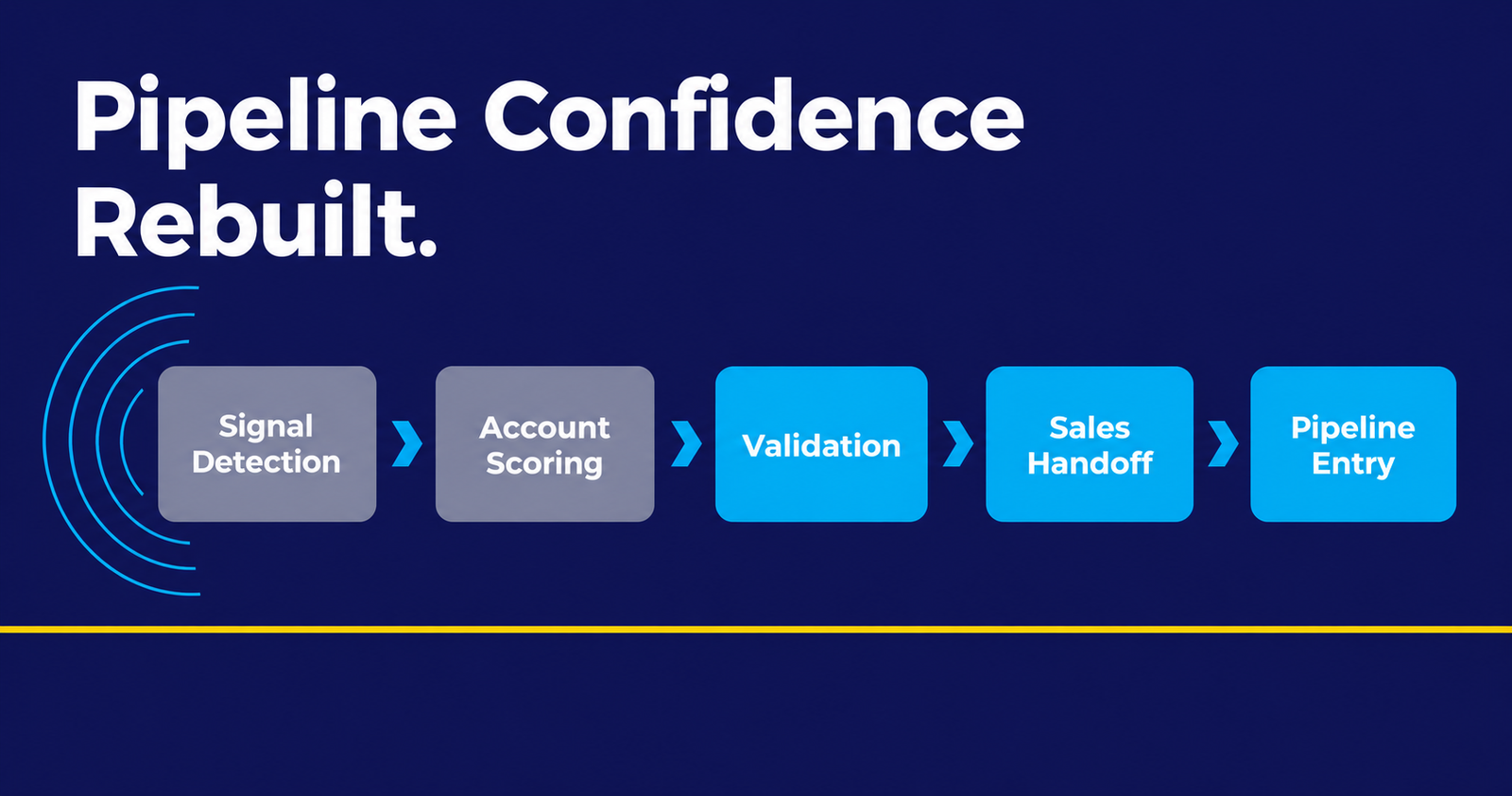
    Market Wavegen’s system operates as a structured flow:

    Signals → Intelligence → Personalization → Validation → Delivery

    Each stage is designed to protect the first 72-hour window.

    Signal-first activation

    Instead of reacting to form fills, outreach is triggered by real behavioral signals such as:

    • Product research
    • Competitor comparison
    • Renewal timing

    Context-rich engagement

    Every interaction is informed by why the lead exists, not just who the lead is.

    ConvrsAI validation layer

    This is where most systems fail and where ConvrsAI changes the outcome.

    ConvrsAI acts as a qualification and validation layer on top of any demand source. It ensures:

    • Buying intent is confirmed
    • Role relevance is verified
    • Timing and urgency are assessed

    Leads are no longer passed to sales as raw data. They are delivered as risk-scored opportunities.

    This eliminates the biggest failure point in the first 72 hours: uncertainty.


    Proof: what happens when you get this right

    Organizations that optimize for the first 72 hours consistently see measurable improvements:

    • Higher meeting acceptance rates
    • Shorter sales cycles
    • Improved opportunity-to-close ratios

    In Market Wavegen programs, the difference is not incremental. It is structural.

    Because only validated, context-rich leads reach sales:

    • Conversations start at the right level
    • Discovery is faster
    • Trust is established earlier

    Instead of spending time qualifying, sales teams spend time advancing deals.

    This is how pipeline becomes predictable rather than probabilistic.


    How to operationalize the first 72-hour window

    If your current system is not built for speed and validation, start here:

    1. Redefine lead ownership

    The first 72 hours should not sit entirely with SDRs. It requires coordinated execution across marketing, data, and qualification layers.

    2. Trigger actions based on signals, not forms

    Form fills are lagging indicators. Prioritize real-time behavioral signals.

    3. Implement a validation layer

    Before sales engagement, confirm:

    • Is this a real buyer
    • Is there real intent
    • Is timing aligned

    This is exactly where solutions like ConvrsAI sit in the stack.

    4. Compress response time to hours, not days

    Every hour matters. The goal is same-day engagement with context.

    5. Align messaging to buyer context

    Reference what the buyer actually did. Generic outreach kills momentum.


    The bigger shift: from leads to validated pipeline

    The first 72 hours after lead capture expose a deeper issue in B2B demand generation.

    Most systems are optimized for:

    • Volume
    • Cost per lead
    • Campaign metrics

    But revenue is driven by:

    • Timing
    • Intent
    • Conversion probability

    Market Wavegen’s approach flips this model entirely:

    • Signal-first targeting
    • Human-validated engagement
    • Pipeline-focused outcomes

    As highlighted in their demand framework, the goal is not more leads. It is fewer, better conversations that actually convert.


    Conclusion

    The first 72 hours after lead capture are not a small optimization window. They are the core of pipeline creation.

    If you miss this moment:

    • Intent fades
    • Context disappears
    • Competitors win

    If you capture it:

    • Conversations improve
    • Sales cycles shorten
    • Pipeline becomes predictable

    The difference is not effort. It is timing, validation, and system design.


    FAQ

    Why are the first 72 hours after lead capture so important?

    Because this is when buyer intent is at its peak. Delayed engagement leads to lost context and lower conversion rates.

    What typically goes wrong in this window?

    Most teams respond too slowly, use generic messaging, and pass unvalidated leads to sales.

    How does ConvrsAI improve this process?

    ConvrsAI validates and qualifies leads before they reach sales, ensuring only real buying intent is acted on.

    Is faster response enough to fix conversion issues?

    No. Speed without context and validation still results in poor-quality conversations.

    What should teams focus on instead of lead volume?

    Focus on signal-driven engagement, validation, and pipeline impact rather than raw lead numbers.

  • Buyer Intent Signals B2B 2026: How to Use 32 Million Daily Signals Before Competitors

    Buyer Intent Signals B2B 2026: How to Use 32 Million Daily Signals Before Competitors

    Buyer intent signals B2B 2026 reveal who is ready to buy. Learn how to act before competitors and convert signals into real pipeline.

    The market is generating signals. Most teams are ignoring them.

    Every day, more than 32 million buyer intent signals are generated across the B2B ecosystem. Buyer intent signals B2B 2026 are not scarce. They are everywhere. The problem is not access. It is interpretation and timing.

    Revenue teams still rely on form fills, gated content, and static lists while buyers research anonymously, compare vendors, and make decisions long before raising a hand.

    The result is predictable. Sales shows up late. Opportunities are already shaped. Competitors are already in the room.

    This article breaks down how to identify, prioritize, and act on buyer signals before your competitors even know the opportunity exists.

    The shift: buying behavior changed faster than demand generation

    In 2026, B2B buying does not follow a funnel. It behaves like a signal network.

    Buyers leave traces everywhere:

    • Product comparison activity
    • Review platform engagement
    • Hiring signals tied to new initiatives
    • Tech stack changes
    • Renewal cycle pressure

    According to research from Gartner (https://www.gartner.com/en/marketing/insights/articles/the-b2b-buying-journey), B2B buyers spend the majority of their journey researching independently before engaging vendors.

    That means by the time a demo is booked, most decisions are already shaped.

    This is exactly why traditional demand generation fails to capture real intent. It waits for buyers to declare interest instead of detecting it early.

    Market Wavegen’s approach, outlined in its demand engine model, focuses on identifying buying intent before outreach begins .

    The shift from data to signal intelligence

    Not all data is equal. Most organizations confuse data volume with signal quality.

    A contact database tells you who exists. A signal tells you who is changing.

    This distinction matters.

    Signal intelligence focuses on:

    • Behavioral change over static attributes
    • Timing over demographics
    • Context over volume

    For example:
    A company downloading an ebook is weak intent.
    A company researching competitors, hiring for a related role, and approaching contract renewal is strong intent.

    The difference is not subtle. It is the difference between noise and opportunity.

    This is where platforms like FlipSignals™ and Mantech Mark™ operate. They do not just collect data. They detect momentum.

    Why old demand generation approaches fail

    Most demand generation systems were built for a different era.

    They assume:

    • Buyers raise their hands early
    • Volume creates pipeline
    • SDRs can qualify interest manually

    None of this holds true anymore.

    Here is what breaks:

    MQL scoring is reactive
    It rewards engagement after interest is already visible.

    Outbound is mistimed
    Cold outreach ignores buying context and lands too early or too late.

    ABM lists go stale
    Static account targeting cannot keep up with real-time buyer movement.

    Sales receives low-context leads
    Without signal data, conversations start blind.

    The result is pipeline inefficiency. More leads, fewer opportunities.

    According to Forrester (https://www.forrester.com/report/the-state-of-b2b-demand-generation/), a large percentage of marketing-generated leads never convert to pipeline because they lack real buying intent.

    Buyer intent signals B2B 2026: The Market Wavegen approach

    The shift is not about collecting more signals. It is about orchestrating them.

    Market Wavegen operates a signal-first demand system built around five layers:

    Signals → Intelligence → Personalization → Validation → Delivery

    At the core are platforms like Mantech Mark™ and FlipSignals™, which monitor millions of behavioral indicators across the market.

    But raw signals are not enough.

    This is where the system becomes differentiated.

    Signals are:

    • Clustered to identify intent patterns
    • Scored based on timing and relevance
    • Mapped to buying committees
    • Activated only when readiness is confirmed

    Then comes the critical layer most organizations miss.

    Validation.

    ConvrsAI sits on top of this signal layer and ensures that only verified buying intent reaches sales.

    It does this through:

    • AI-led voice and email qualification
    • Role and firmographic validation
    • Confidence scoring based on real conversations

    Instead of passing leads, the system delivers risk-scored opportunities.

    That is the difference between activity and pipeline.

    What this looks like in practice

    A typical signal-driven opportunity does not start with a form fill.

    It starts with a pattern.

    For example:

    • A target account begins researching a competitor
    • Hiring activity indicates expansion in a relevant department
    • Technology usage signals suggest a gap your solution fills
    • Renewal timing suggests upcoming decision pressure

    Individually, these signals mean little.

    Combined, they indicate buying readiness.

    Market Wavegen activates outreach only when multiple signals align. This removes guesswork and replaces it with precision timing.

    The outcome is not more conversations. It is better conversations.

    Proof: signal-driven execution changes pipeline math

    In traditional models, 1,000 leads might produce a fraction of meaningful opportunities.

    In a signal-driven model:

    • Outreach volume decreases
    • Conversion rates increase
    • Sales cycles shorten

    Because conversations happen at the right moment.

    Market Wavegen’s system ensures that nothing reaches sales without validation of:

    • Intent
    • Timing
    • Role relevance

    This dramatically reduces wasted effort and improves close probability.

    As highlighted in the company’s demand framework, the goal is not lead generation. It is predictable pipeline creation through verified demand .

    How to start using buyer signals before competitors

    You do not need to rebuild your entire GTM strategy overnight. But you do need to change how you prioritize action.

    Start here:

    1. Stop measuring volume as success
    Shift from leads to opportunities.

    2. Identify high-value signal sources
    Focus on behavioral data, not just firmographics.

    3. Layer signals instead of reacting to single triggers
    One signal is noise. Multiple signals create clarity.

    4. Align sales and marketing on signal interpretation
    Both teams must operate from the same intelligence layer.

    5. Add a validation layer before sales handoff
    This is where most pipeline collapses.

    For a deeper breakdown of signal-first demand systems, explore https://marketwavegen.com/signal-demand-engine.

    The competitive advantage is timing, not targeting

    Most companies target the right accounts.

    Few engage at the right time.

    That is the real gap.

    Buyer intent signals B2B 2026 are not about better targeting. They are about earlier entry into the decision cycle.

    The companies that win are not louder. They are earlier, more relevant, and more precise.

    Conclusion

    The market is not short on demand. It is short on visibility.

    32 million daily buyer signals represent a massive opportunity. But only for teams that know how to interpret and act on them.

    Signal-first demand generation changes the equation:

    • From guessing to knowing
    • From volume to precision
    • From leads to pipeline

    The question is no longer whether signals exist.

    It is whether you are using them before your competitors do.

    FAQ

    What are buyer intent signals in B2B?
    Buyer intent signals are behavioral indicators that show when a company is actively researching, evaluating, or preparing to purchase a solution.

    Why are buyer signals important in 2026?
    Because buyers complete most of their journey before engaging vendors, early signal detection is critical to entering deals at the right time.

    How are signals different from leads?
    Leads are declared interest. Signals are observed behavior. Signals appear earlier and provide better timing context.

    What tools help capture buyer intent signals?
    Platforms like FlipSignals™ and Mantech Mark™ aggregate and analyze behavioral data, while systems like ConvrsAI validate and qualify that intent.

    How can sales teams use buyer signals effectively?
    By focusing outreach on accounts showing multiple aligned signals and engaging with context instead of generic messaging.

  • MQL is Dead 2026: Signal-First Demand Wins Pipeline

    MQL is Dead 2026: Signal-First Demand Wins Pipeline

    MQL is dead 2026. Learn why signal-first demand replaces leads with real buyer intent and how to build pipeline that converts. Discover how.

    Introduction

    MQL is dead 2026 is no longer a bold opinion. It is operational reality inside high-performing B2B teams. Marketing qualified leads once defined pipeline health. Today, they inflate dashboards while revenue stalls.

    Teams are generating more leads than ever, yet conversion rates continue to decline. The gap between activity and pipeline has widened.

    This article explains why MQLs have broken, what signal-first demand really means, and how to shift toward a system that produces predictable pipeline.

    CONTEXT & THE PROBLEM

    The shift away from MQLs is tied to a deeper change in how B2B buying works. Buyers no longer move in linear funnels. They research anonymously, validate options internally, and engage vendors late.

    According to Gartner, B2B buyers spend only 17 percent of their journey meeting suppliers, with the rest happening independently.

    The result is predictable. Sales teams inherit contacts, not opportunities. SDRs chase form fills that never convert. Marketing celebrates volume while revenue teams struggle to forecast.

    The core issue is not lead quality. It is the model itself. MQLs assume intent based on isolated actions.

    In 2026, that assumption breaks. Intent is not declared. It is observed through signals.

    The Shift

    The shift is from static leads to dynamic signals.

    Instead of asking who filled a form, signal-first demand asks who is actively moving toward a buying decision. This includes behaviors across channels, timing indicators, and contextual triggers.

    Examples of high-value signals include:

    • Increased research activity around a specific category
    • Engagement with competitor content or pricing pages
    • Hiring signals tied to a new capability build
    • Technology changes that create replacement pressure

    These signals do not exist in isolation. They form patterns. When multiple signals align, they indicate movement inside a buying group.

    Modern demand systems track these patterns continuously. They prioritize accounts based on momentum, not arbitrary scoring thresholds.

    This is where signal intelligence changes execution. Instead of pushing campaigns to cold audiences, teams activate outreach when timing is right.

    The difference is subtle but powerful. Demand generation shifts from volume creation to opportunity capture.

    Why Old Approaches Fail

    MQL frameworks fail because they measure activity, not intent.

    A lead scoring model might assign points for email clicks, page visits, and downloads. These actions are easy to track but weak indicators of buying readiness. They create false positives at scale.

    Sales teams feel this immediately. Large portions of MQLs never respond. Others engage briefly but stall. Pipeline velocity slows, and forecasting becomes unreliable.

    Manual SDR qualification does not fix the problem. It simply shifts the burden downstream. Reps spend hours filtering noise instead of engaging real opportunities.

    Generic ABM programs face a similar issue. Target lists are often static, refreshed quarterly, and disconnected from real-time buyer movement. Outreach becomes mistimed and irrelevant.

    The hidden cost is significant:

    • SDR productivity drops due to low-quality outreach
    • Marketing budgets inflate without proportional pipeline impact
    • Sales cycles extend because engagement starts too early

    MQLs were designed for a different era. In 2026, they create friction across the entire revenue engine.

    Signal-First Demand Generation B2B — The Market Wavegen Approach

    Signal-first demand generation B2B replaces assumptions with evidence.

    At Market Wavegen, this approach is built around FlipSignals™, a system that detects real-time buyer intent across accounts and surfaces when action should happen.

    FlipSignals™ tracks behavioral patterns such as research spikes, competitor interactions, and timing triggers like contract renewals. These signals are mapped against buying group dynamics, not individual contacts.

    This changes execution in three ways:

    First, targeting becomes dynamic. Accounts move in and out of priority based on live signals. There is no static list.

    Second, messaging becomes contextual. Outreach reflects what the buyer is already experiencing, not generic value propositions.

    Third, timing becomes precise. Teams engage when internal momentum exists, not when a lead score crosses a threshold.

    This aligns directly with a pipeline-first philosophy. Every action is tied to revenue potential, not activity metrics.

    The result is fewer leads, but significantly higher pipeline quality.

    Proof Point

    In one mid-market SaaS program, shifting from MQL-based targeting to signal-first activation reduced total lead volume by 38 percent. At the same time, opportunity creation increased by 52 percent.

    The key change was timing. FlipSignals™ identified accounts showing early signs of dissatisfaction with incumbent vendors. Outreach was triggered within a narrow window when internal discussions were already happening.

    Sales cycles shortened by 21 percent because conversations started later in the buying journey.

    Practical Tips

    • Audit your last 100 MQLs and identify how many converted to opportunities
    • Map common signal patterns across your last 20 closed deals
    • Reduce SDR outreach to low-intent segments and reallocate effort to high-signal accounts
    • Align marketing campaigns with known trigger events such as renewals or funding rounds
    • Explore signal layer integration within your CRM workflows

    Summary

    MQL is dead 2026 because it measures the wrong thing. Activity does not equal intent.

    Signal-first demand identifies when buyers are moving and aligns outreach with real timing.

    If your pipeline still depends on lead volume, the gap between marketing and revenue will continue to grow.

    Move from lead tracking to signal tracking and build a predictable pipeline engine.

    Talk to Market Wavegen to see how FlipSignals™ can transform your demand generation.

  • The 90% Problem: Why Your Demand Generation Strategy Is Built on Sand – CEO Perspective

    The 90% Problem: Why Your Demand Generation Strategy Is Built on Sand – CEO Perspective

    Most revenue leaders are looking at dashboards that seem healthy. Lead volume is rising, campaign activity looks strong, and top-of-funnel metrics appear stable.

    But inside leadership meetings, a different conversation is starting to happen. Pipeline quality is slipping, forecast confidence is getting weaker, and sales teams are working harder while seeing fewer real opportunities.

    So the question many organizations are now asking is simple. Are we truly generating demand, or are we just collecting contacts?

    The Illusion of Pipeline Growth

    Here is a scenario playing out across modern B2B companies. Your marketing team generates 1,000 leads, sales reaches out to hundreds of them, yet only a small percentage turn into serious opportunities.

    On paper, this looks like growth. In reality, it is often pipeline inflation. There is activity, but it does not translate into revenue.

    Something important has changed. This is not a lead generation problem. It is a lead validation problem.

    Buyer Behavior Has Permanently Shifted

    Today’s buyers operate differently than they did just a few years ago. They research independently, compare vendors before speaking to sales, and build strong opinions early in the journey.

    By the time a prospect enters a conversation, much of the decision process is already behind them. Large lead databases once felt like a competitive advantage, but now they can introduce risk when quality is uncertain.

    More leads do not automatically create more revenue. Stronger signals do.

    The Hidden Cost Revenue Teams Often Miss

    When unverified leads enter the pipeline, the impact spreads quickly across the organization. Sales capacity gets consumed by qualification instead of closing, deal cycles become longer, forecast accuracy drops, and customer acquisition costs begin to climb.

    Yet the most dangerous effect is often overlooked. Revenue volatility.

    Volatility makes it harder to plan, hire, invest, and scale with confidence.

    This Is a Structural Challenge, Not a Tool Gap

    Many organizations respond by adding more technology, more automation, or additional scoring models. But this is not simply a tactical issue. It is a design problem within the revenue engine itself.

    The companies moving ahead are rethinking how demand is identified, validated, and delivered to sales. They are building systems that reflect how buyers actually behave today.

    What they are doing differently is explored in detail inside the CEO Revenue Intelligence Report.

    Why This Report Matters Right Now

    The gap between lead activity and revenue outcomes is widening across industries. Organizations that recognize this early can redesign their demand engines and create more predictable pipeline.

    Those that delay often continue optimizing surface metrics while conversion quietly declines.

    Leadership teams are starting to shift the question they ask. It is no longer “How many leads did we generate?” It has become “How many of them were real buyers?”

    The answer increasingly determines who leads their category and who struggles to keep pace.

    CTA Section

    CEO Revenue Intelligence Report: Demand Generation Performance Transformation

    Inside the report, you will discover:

    • The underlying cause behind the 90 percent pipeline failure pattern
    • What high-performing revenue teams are doing differently
    • The emerging model reshaping modern demand generation
    • How signal-led strategies are improving opportunity quality
    • What it takes to move from pipeline volume to pipeline precision

    Download the full report to explore the complete executive framework.