Most sales wasted effort does not happen in the sales call. It happens before it.
It happens when a rep dials a number that has been disconnected for three months. When they spend forty minutes preparing for a discovery call with someone who has no budget authority. When they build a sequence for a company that stopped fitting the ICP six quarters ago but nobody updated the CRM. When they follow up twelve times on a lead that was never genuinely interested — just polite.
These are not isolated failures. They are the structural output of a lead generation process that prioritises volume over verification. And they are expensive. Research from Salesforce consistently shows that sales reps spend less than a third of their time actually selling — the remainder goes to administrative tasks, data cleanup, and chasing leads that should never have been handed over in the first place.
AI-powered lead verification changes this equation. Not by generating more leads, but by ensuring that the leads entering the pipeline have been confirmed against the dimensions that actually determine whether a sales conversation has a chance.
Why Traditional Lead Verification Falls Short
Legacy lead verification is largely a contact hygiene exercise. It asks: is this email address valid? Does this phone number connect? Is the company name spelled correctly?
These checks matter. But they answer the wrong question. An email that delivers and a phone that rings tell you nothing about whether the person on the other end has the authority to buy, whether their company fits your ideal customer profile, or whether there is an active reason for them to be evaluating your category right now.
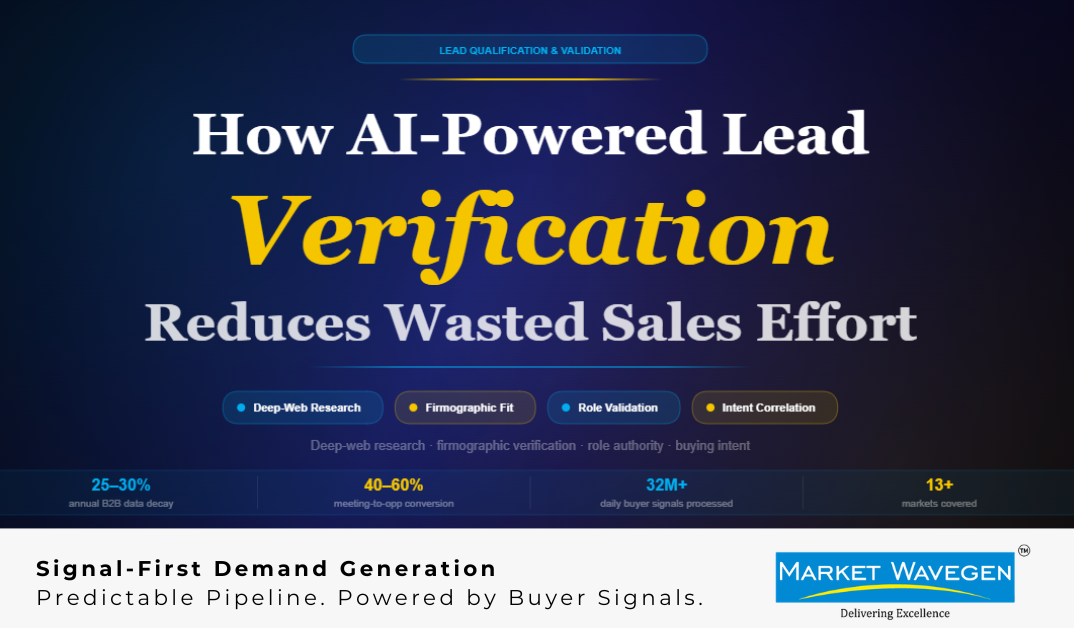
Traditional verification also degrades fast. B2B contact data has an annual decay rate of 25–30% according to Dun & Bradstreet. People change roles, companies restructure, buying teams shift. A database that was clean in January is carrying significant inaccuracy by Q3 — and most organisations are not refreshing data at anything close to that frequency.
The result is a hidden tax on sales productivity. Reps accept handoffs from marketing with no reliable way to know whether the underlying data is current, whether the contact is the right person, or whether the account is genuinely in-market. They find out through wasted conversations and missed quota.
What AI-Powered Lead Verification Actually Does
AI-powered lead verification is not a smarter email validator. It is a multi-layer intelligence process that runs against each lead before it reaches sales — confirming not just contact accuracy but role legitimacy, firmographic alignment, and market behaviour.
The process works across four distinct verification layers.
Layer 1 — Deep-Web Contact Research
The first layer goes beyond the CRM record. AI systems trained on live web data can cross-reference a contact against their current LinkedIn profile, company website, published content, event speaker records, press mentions, and regulatory filings to confirm that the person exists as described, is still at the stated company, and holds a role consistent with what was captured.
This deep-web research surfaces discrepancies that standard contact validation misses entirely:
- A VP of Marketing who left the company four months ago may still be in your database — and still have a valid company email if the domain is not managed tightly
- A job title that read “Head of Procurement” may now read “Director of Operations” at a different company
- An email address may still deliver while the person has moved to a competitor
AI verification catches these cases at scale and flags them before they reach the sales queue. The output is not just a valid contact — it is a confirmed, current contact at the right organisation.
Market Wavegen’s verification process combines AI-powered deep-web research with human tele-validation to confirm every contact against their stated role and company before any outreach begins. The combination matters: AI provides scale and speed; human validation catches edge cases that automated systems misread.
Layer 2 — Firmographic Verification
The second layer confirms that the company itself still fits the criteria that made it a target in the first place.
Firmographic data — company size, industry vertical, revenue band, headcount, technology stack, geographic footprint — changes continuously. A mid-market SaaS company that was 200 employees when it entered your database may have grown to 800 and moved upmarket, or may have been acquired and absorbed into a larger entity, or may have reduced headcount and moved outside your serviceable range.
AI systems can verify current firmographic status against live sources including company websites, LinkedIn company pages, Crunchbase, Companies House filings, funding announcements, and industry databases. The verification answers a different set of questions than contact hygiene:
- Is the company still operating independently?
- Has its headcount or revenue changed materially since the lead was first captured?
- Has it been acquired, merged, or restructured?
- Is it still in the industry vertical your solution is built for?
- Does its current technology stack still indicate a need for your category?
Firmographic drift is one of the most underrecognised sources of wasted sales effort. A company that fitted your ICP perfectly eighteen months ago may have undergone changes that make it a poor target today — but without automated verification, that lead stays in your nurture queue, consuming resources and eventually generating a wasted sales engagement.
Intelligent Database ABM™, Market Wavegen’s firmographic matching engine, runs continuous ICP alignment checks against live company data across 13+ markets — ensuring that accounts in the pipeline reflect current reality, not snapshot data from the day they were first captured.
Layer 3 — Role and Authority Validation
The third layer addresses the question that traditional verification ignores entirely: does this person have the authority to move a purchase decision forward?
Role validation is distinct from title matching. A title match confirms that someone has the word “Director” or “VP” in their job description. Role validation confirms that they have actual decision-making authority or procurement influence in the specific category your solution addresses.
This matters because titles are inconsistent across organisations:
- A “Director of Sales Operations” at a 50-person company may own technology purchasing decisions outright
- The same title at a 5,000-person enterprise may have no procurement authority at all — that sits with a centralised procurement function they never interact with
- A title match would treat both leads identically. Role validation does not.
AI-powered role validation cross-references reporting structure indicators, published content and conference participation in the relevant domain, LinkedIn activity and engagement with vendor content in the category, and historical patterns from comparable contacts at similar companies.
The output is a calibrated confidence assessment for decision-making authority — not a binary yes/no, but a layered signal that allows sales and marketing to prioritise contacts most likely to advance a purchase.
Market Wavegen’s tele-qualification layer adds a direct human check on top of the AI assessment — confirming authority through a brief qualification conversation before the lead is handed to sales. This removes the uncertainty that even well-calibrated AI scoring carries at the individual contact level.
Layer 4 — Buying Signal and Intent Correlation
The fourth layer moves beyond the static lead record to assess real-time market behaviour.
A contact who passes identity, firmographic, and role validation is a qualified target. But they are not necessarily a sales-ready lead unless there is evidence of active buying behaviour in your category. Verification without intent correlation can produce a pipeline full of well-qualified contacts who are not in-market — which still generates wasted sales effort, just at a later stage in the funnel.
AI systems correlate a verified contact against live intent signals:
- Third-party content consumption on review sites, industry forums, and research platforms
- Search behaviour indicating active evaluation of vendor options
- Engagement with competitor content or competitor review threads
- Trigger events at the account level — new executive hires, funding announcements, technology procurement signals, contract renewal windows approaching
- Social signals indicating dissatisfaction with an incumbent vendor
Mantech Mark™, Market Wavegen’s signal intelligence engine, processes over 32 million buyer signals daily across web, social, and intent data platforms. When a verified lead is correlated against active intent signals, the result is not just a clean contact — it is a confirmed in-market opportunity.
The difference in conversion rates is measurable. Market Wavegen’s programmes deliver meeting-to-opportunity conversion rates of 40–60%, compared to 15–25% in volume-based demand generation — because verification and intent correlation together ensure that sales conversations begin with contacts who are ready to have them.
The Compounding Effect on Sales Productivity
The case for AI-powered lead verification is ultimately a productivity argument.
Every wasted sales call carries a direct cost: the rep’s time, the sequence investment, the opportunity cost of not calling a better lead. But the indirect costs are often larger. Reps who consistently receive poor-quality leads lose confidence in the pipeline. They start their own informal verification processes — Googling contacts, checking LinkedIn before calling, asking SDRs to re-qualify before they engage. These are rational responses to a broken handoff process, but they consume exactly the time verification should have freed up.
When verification is robust and systematic, the dynamic reverses. Sales receives contacts they can trust. Preparation time drops. Confidence in the pipeline increases. Call quality improves because reps are not walking into conversations with unresolved questions about whether the person is the right contact at the right company. Discovery moves faster because the foundational qualification has already been done.
The downstream effects extend to pipeline forecasting. A pipeline built on verified leads has less variance in conversion rates — which means forecast accuracy improves, resource planning becomes more reliable, and revenue leaders can make better decisions about where to invest in additional capacity.
What to Look for in an AI Lead Verification Partner
Not all AI-powered verification operates at the same depth. When evaluating a solution or partner, the questions that matter are:
Does it verify role authority, or just title? Title matching is not role validation. A genuine verification process should be able to distinguish a procurement-influencing VP from a VP in name only.
How current is the underlying data? Verification is only as good as the data it runs against. Partners should be able to demonstrate the refresh frequency of their reference datasets and their methodology for detecting stale records.
Does it include intent correlation, or just contact hygiene? A verified contact who is not in-market generates wasted effort at a later stage. True verification should include some assessment of buying behaviour, not just static record accuracy.
Is there a human validation layer? AI verification is powerful at scale, but calibrated confidence scores are not certainties. A human tele-qualification layer that confirms intent, authority, and timing through a direct conversation closes the gap between AI assessment and sales-ready certainty.
Is it compliant across your target markets? B2B outreach in the EU, UK, and increasingly in APAC markets operates under strict data handling requirements. A verification partner operating across these markets should carry relevant certifications — ISO 27001, ISO 27018, and EU GDPR compliance at minimum.
Market Wavegen’s programmes are ISO 9001, ISO 14001, ISO 27001, ISO 27018, ISO 37001, and EU GDPR certified — operating across 13+ markets with regional execution teams who conduct qualification in the buyer’s language and time zone.
Verification Is Not an Additional Step. It Is the Foundation.
The framing that treats lead verification as a pre-sales hygiene task misses what it actually is: the foundation on which reliable pipeline is built.
Without it, sales teams are working on unconfirmed assumptions. The contact might be the right person. The company might still fit. There might be a reason to buy. Every call carries that uncertainty — and uncertainty at scale produces the wasted effort that depresses sales productivity, distorts pipeline data, and erodes the relationship between sales and marketing.
AI-powered verification removes the uncertainty before it reaches the rep. Not by slowing the pipeline down, but by ensuring that what flows through it has been confirmed against the dimensions that actually predict conversion: identity verified, role validated, firmographic fit confirmed, buying intent detected.
Sales effort applied to verified leads is not just more efficient. It converts at a fundamentally different rate — because it starts from a fundamentally different foundation.
How Market Wavegen Verifies Before Sales Engages
Market Wavegen’s six-layer lead validation process applies AI-powered deep-web research, firmographic verification, role and authority validation, and Mantech Mark™ intent signal correlation to every lead before it reaches your sales team.
Every programme includes human tele-qualification as the final confirmation layer — ensuring that timing, budget alignment, and decision-maker readiness are confirmed through a real conversation, not inferred from a score.
The result is a pipeline your sales team can trust — and a conversion rate that reflects it.
Leave a Reply