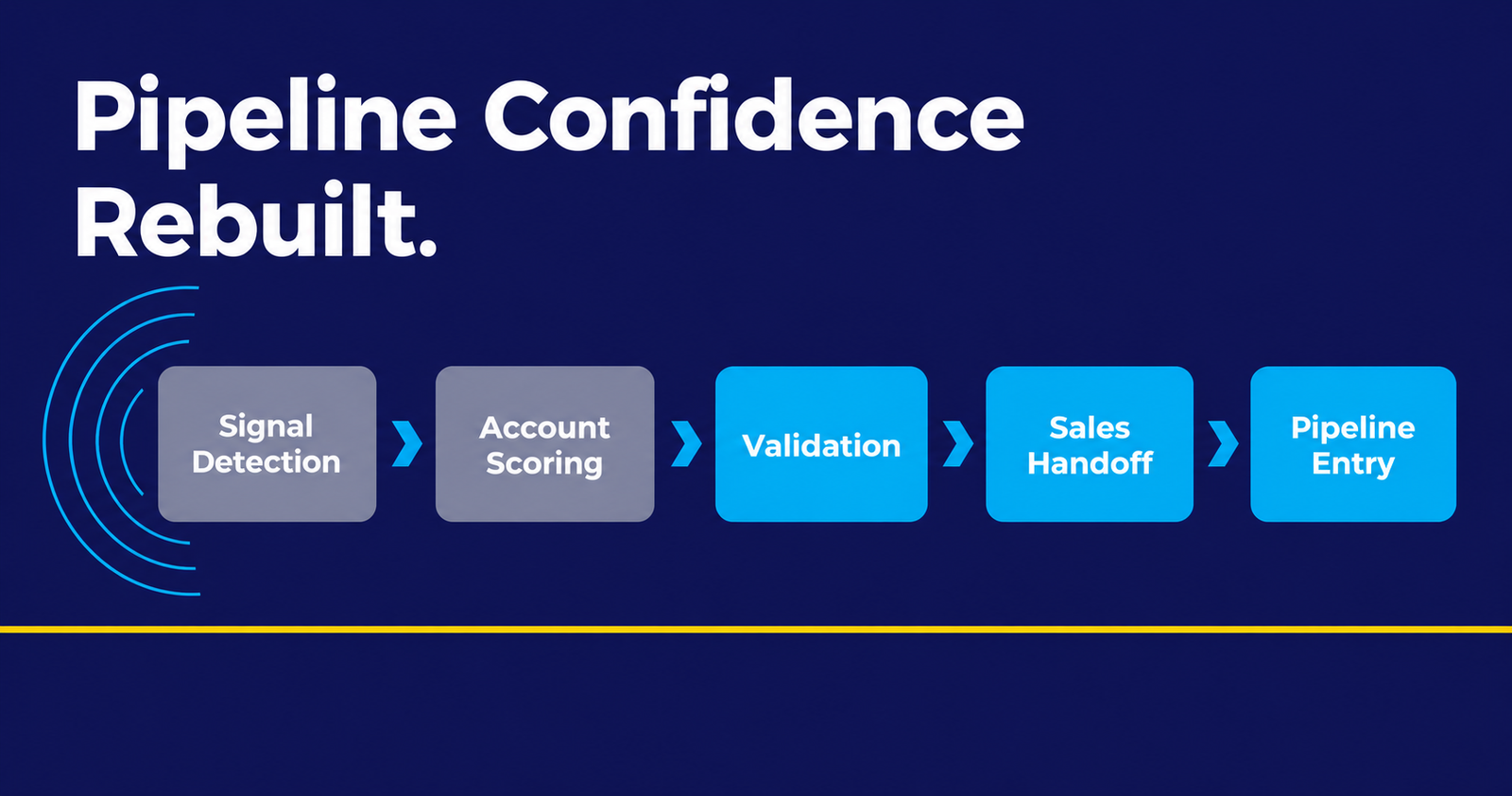
The Scene That Plays Out Every Quarter
The CRM looks healthy. The pipeline number is strong. The sales team sounds confident. The CFO signs off on the forecast.
Then the quarter closes — and the numbers miss.
This is not a sales execution problem. It is not a messaging problem. It is not even a lead volume problem.
It is a pipeline confidence problem — and it starts the moment your team begins treating activity as intent.
Why Most B2B Pipelines Cannot Be Trusted
Every B2B revenue leader has felt the weight of this question: Why does our pipeline consistently fail to convert at the rate we forecast?
The answer is structural. The average enterprise pipeline contains between 40% and 60% of deals that will never close — not because the sales team lacks skill, but because the accounts entered the pipeline before they were genuinely ready to buy.
They filled a form. They downloaded a report. They opened three emails. None of these actions signal buying readiness. All of them signal vague awareness at best.
When your pipeline is built on activity signals — clicks, opens, page visits, form fills — it looks full. It feels real. But it collapses when sales engages, because the underlying intent was never there.
The result is familiar:
- Sales cycles lengthen as teams invest time in accounts that are not yet ready
- Win rates decline because discovery conversations start with buyers who are still in research mode
- Forecast accuracy erodes quarter after quarter as CFO trust in projections weakens
- Marketing doubles down on volume to compensate for low conversion — making the problem worse, not better
- The gap between pipeline and revenue becomes structural, not temporary
This is the pipeline confidence crisis. And it is not solved by more leads. It is solved by better evidence.
The Real Problem: Activity Is Not Intent
Traditional lead scoring models were built to solve exactly this problem. They assigned numerical values to buyer actions and used accumulated scores to prioritise outbound effort. In a world where buyer journeys were linear and predictable, this approach made reasonable sense.
In 2026, it no longer does.
Today’s B2B buyers research anonymously. They compare vendors in communities your tracking pixels cannot reach. They build evaluation shortlists in Slack channels and peer review forums before your SDR ever sends the first email. They involve procurement, legal, and finance weeks before any vendor contact is made.
By the time a contact scores highly in your marketing automation platform, they may already be three months into an evaluation cycle your team knows nothing about — and two of your competitors are already on their shortlist.
This is the signal gap. And it is the structural cause of every pipeline confidence failure.
The question your current system is asking is: “What did this person do on our website?”
The question that actually predicts pipeline is: “What is this account actively doing in the market right now?”
These are different questions. They produce different data. And they produce profoundly different pipeline quality.
What Signal Intelligence Actually Measures
Signal intelligence does not replace demand generation. It upgrades the evidence layer beneath it — replacing activity scores with behavioural intent that exists in the market, not just on your owned channels.
At Market Wavegen, every program runs on Mantech Mark™, our ISO-certified signal intelligence platform that analyses more than 32 million daily buyer signals across industries, geographies, and buying journeys.
Mantech Mark™ monitors five categories of real-market intent:
1. Research Behaviour The earliest indicator of active consideration. When an account begins investigating a category — not a specific vendor, but the problem category — it reveals the opening of a buying window before most competitors can see it.
2. Product Comparisons Side-by-side vendor evaluations signal shortlist-stage activity. An account comparing your category at this depth is not browsing. They are building a decision architecture.
3. Competitor Dissatisfaction Negative sentiment, contract complaints, churn indicators, and public switching intent. When a buyer is frustrated with their current vendor, there is a narrow window of high receptivity to alternatives. Flip Signals™ — our emotional buyer intent layer — captures not just what buyers do, but why they are doing it, detecting frustration, urgency, and optimism as distinct emotional signals.
4. Renewal and Contract Cycles Predictable pipeline entry windows tied to existing vendor contract dates. Accounts approaching renewal are structurally open to re-evaluation. Knowing when this window opens — before the account formally enters a buying process — is the single most reliable source of early-stage competitive advantage.
5. Hiring and Expansion Signals New role postings, leadership transitions, funding announcements, and geographic expansion all indicate budget availability and organisational readiness to invest. These are buying readiness signals hiding in plain sight.
Signal intelligence does not tell you what buyers did on your website. It tells you what they are doing in the market — before they ever visit your website.
Leave a Reply